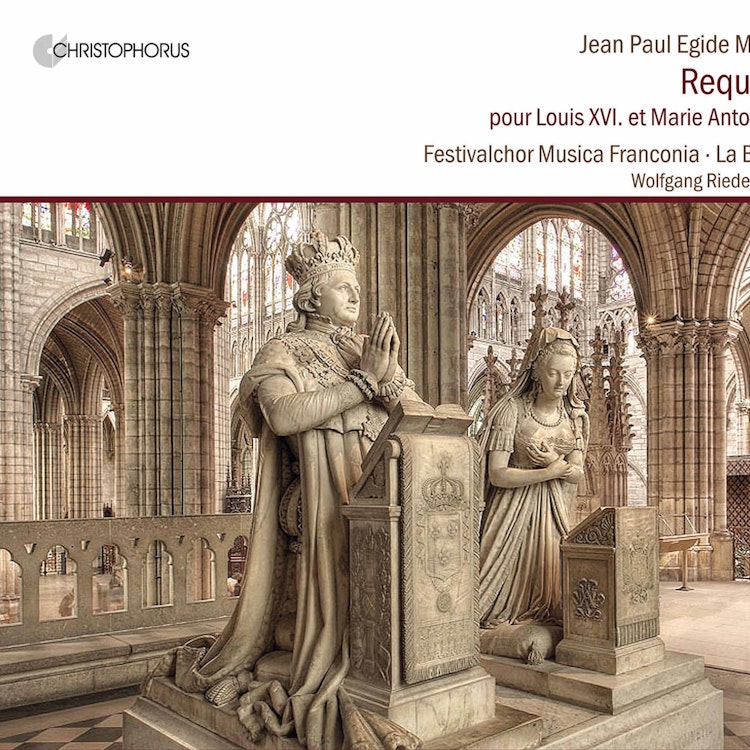
Martini: Requiem pour Louis XVI et Marie Antoinette
2/17/2017, 13 Tracks, 1:13:46
Featuring
Wolfgang Riedelbauch
Corinna Schreiter
Markus Simon
Martin Platz
La Banda
Musica Franconia Festival Choir
Christoph Willibald Gluck
Jean-Paul-Égide Martini
Did you know?
1/7
Historical Context
Jean Paul Egide Martini's Requiem was commissioned as part of a Bourbon restoration strategy to reinterpret the French Revolution and Napoleon's era as an illegitimate phase of French history.
Compositional Technique
Christoph Willibald Gluck's 'De profundis' features an unusual orchestral scoring, lacking violins and high wind instruments, instead using lower register strings, obbligato bassoon, three trombones, a French horn, and a single oboe.
Compositional Technique
Martini's Requiem deviates from the traditional Latin funeral mass by omitting the 'Libera me' and 'In paradisum' sections and inserting two movements, 'Elevatione' and 'Noli meminisse', from the apocryphal book of Baruch.
Compositional Technique
Martini's Requiem includes a tam-tam (a large metal gong), an instrument unusual for German sacred works of the period, likely adopted from French Revolutionary funerary music.
Notable Performances
Martini's Requiem was first performed on January 21, 1816, in the Cathedral of Saint Denis, exactly a year after the execution of Louis XVI, for whom it was composed.
Composer Biography
Jean Paul Egide Martini's Requiem was his final major composition; he died three weeks after its premiere, and the work was performed at his own state funeral.
Composition History
Jean Paul Egide Martini, born in Freystadt, Upper Palatinate, was appointed 'Surintendant de la musique du roi' in 1788, but could only assume this highest position in French musical life 26 years later in 1814 due to the French Revolution.
You might also enjoy...
Roger Norrington conducts Sacred Music
Barenboim & Chicago Symphony Orchestra - The Erato-Teldec Recordings, Vol.3