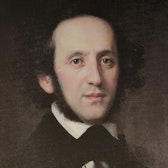
Mendelssohn: A Midsummer Night's Dream
(with spoken text and melodramas in English)
1/27/2011, 17 Tracks, 1:16:39
Featuring
Adrian Grove
Anne-Marie Piazza
David Timson
Emily Raymond
Gunnar Cauthery
James Judd
Jenny Wollerman
Pepe Becker
Jonathan Peter Kenny
Tom Mison
New Zealand Symphony Orchestra
Nota Bene Choir
Varsity Voices
Felix Mendelssohn Bartholdy
Did you know?
1/7
Instruments
Mendelssohn jokingly claimed to have broken new ground in his Overture by using the ophicleide, a now long-forgotten wind instrument.
Compositional Technique
Mendelssohn used motifs to characterize elements of the plot and characters, such as Bottom's braying and Puck's mischief, in the Overture.
Compositional Technique
The incidental music for A Midsummer Night's Dream reflects the play's dual worlds of humanity and the fairy kingdom, with distinct musical characterizations.
Composer's Artistic Vision
Mendelssohn's Overture to A Midsummer Night's Dream was inspired by Shakespeare's imaginative portrayal of Oberon's fairy kingdom.
Interpretation
This recording includes Mendelssohn's 'melodramas,' musical accompaniments to spoken text, to recreate a lavish 19th-century Shakespearean production.
Composition History
Mendelssohn wrote the incidental music for A Midsummer Night's Dream sixteen years after the Overture, for a production directed by Ludwig Tieck.
Composition History
Mendelssohn composed the famous Overture to A Midsummer Night's Dream at the age of seventeen in 1826, initially as a piano duet.