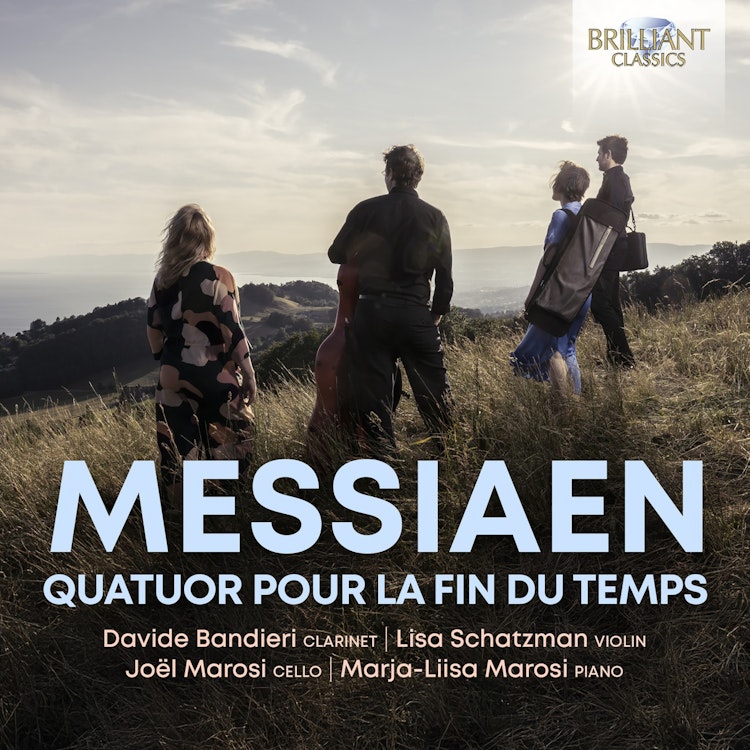
The unusual instrumentation of the Quatuor pour la fin du Temps (clarinet, violin, cello, and piano) was dictated by the availability of musicians and instruments among the prisoners in the Stalag.
Composer's Artistic Vision
Messiaen possessed a special synesthetic faculty, allowing him to 'see' colored sounds and 'hear' colors, which influenced the multicoloured images and harmonies in the Quatuor.
Composition History
Olivier Messiaen composed his Quatuor pour la fin du Temps (Quartet for the End of Time) while imprisoned in Stalag VIII A, a German labor camp, where it premiered on January 15, 1941.
Compositional Technique
Messiaen's innovative language in the Quatuor disrupts traditional metric-accentual systems, using irregular rhythms, prime numbers, and palindromic rhythms inspired by Greek metrics, Hindu theory, and birdsong.
Historical Context
Despite the harsh conditions of the Stalag, the musicians received 'privileges' like extra bread, rehearsal time, and materials for composing, with a cello purchased for Étienne Pasquier by fellow prisoners.
Composer's Artistic Vision
Messiaen's Quatuor pour la fin du Temps was inspired by the first six verses of the tenth chapter of the Apocalypse of John, which he re-read during his imprisonment.
Composer's Artistic Vision
Messiaen, an expert ornithologist, incorporated bird songs into his music, distinguishing and transcribing them 'on a human scale' for pieces like the 3rd movement, Abîme des oiseaux.
You might also enjoy...
Messiaen: Quatuor pour la fin du Temps
Messiaen: Quatuor pour la fin du temps (Quartet for the End of Time)
Ramsoe: Brass Quartets Nos. 1, 2, 4 and 5
Krommer: Clarinet Quartets
Krommer, F.: Clarinet Quartets, Opp. 21, 82, 83
Pugni: Three Quartets for Clarinet and String Trio