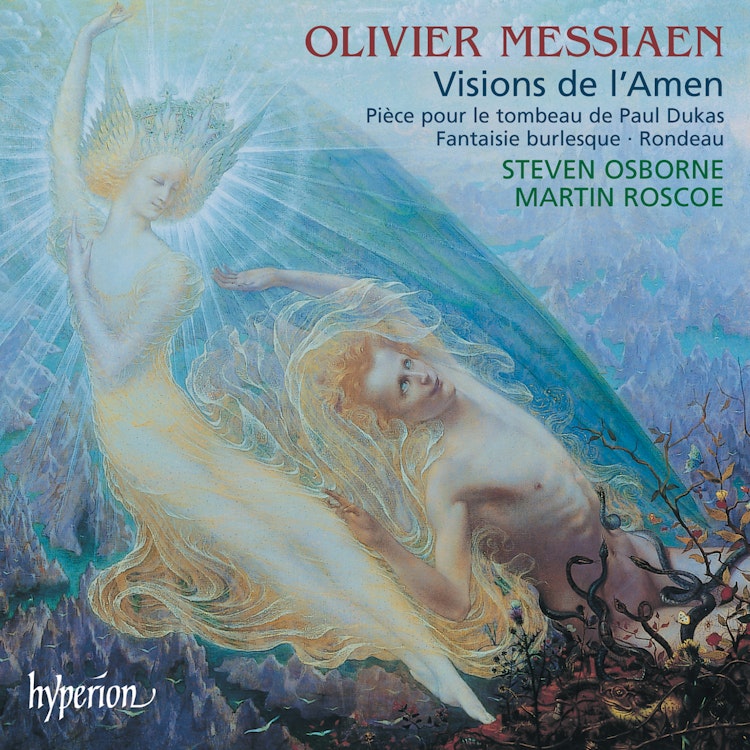
The premiere of Visions de l'Amen took place in Paris during the German Occupation, with "draconian" security measures to prevent undesirable Germans or collaborators from attending.
Critical Reception
Arthur Honegger, a composer present at the premiere of Visions de l'Amen, praised its "great musical richness and of true grandeur in its conception," despite its unusual two-piano scoring.
Composition History
Messiaen's Visions de l'Amen was commissioned by Denise Tual, organizer of the Concerts de la Pléiade, after she was deeply moved by his organ playing.
Compositional Technique
The Piano I part of Visions de l'Amen, written for Yvonne Loriod, features sparkling passagework, complex rhythmic canons, and cascades of chords, while Piano II (Messiaen's part) often controls the music's pacing.
Composer Biography
Messiaen admitted that his Fantaisie burlesque, written in 1932, was an unsuccessful attempt to prove his friends wrong about him being too serious and contemplative.
Composer's Artistic Vision
Messiaen described his Pièce for the 'tombeau' (memorial volume) of his teacher Paul Dukas as "static, solemn and stark, like a huge block of stone."
Composition History
Messiaen composed Visions de l'Amen in the apartment of André Dubois, a former police director and art patron, because his own piano at home was inadequate.
You might also enjoy...
Messiaen: Petites esquisses, Etudes de rythmes, Canteyodjaya, Hommage P. Dukas, Prelude 1964