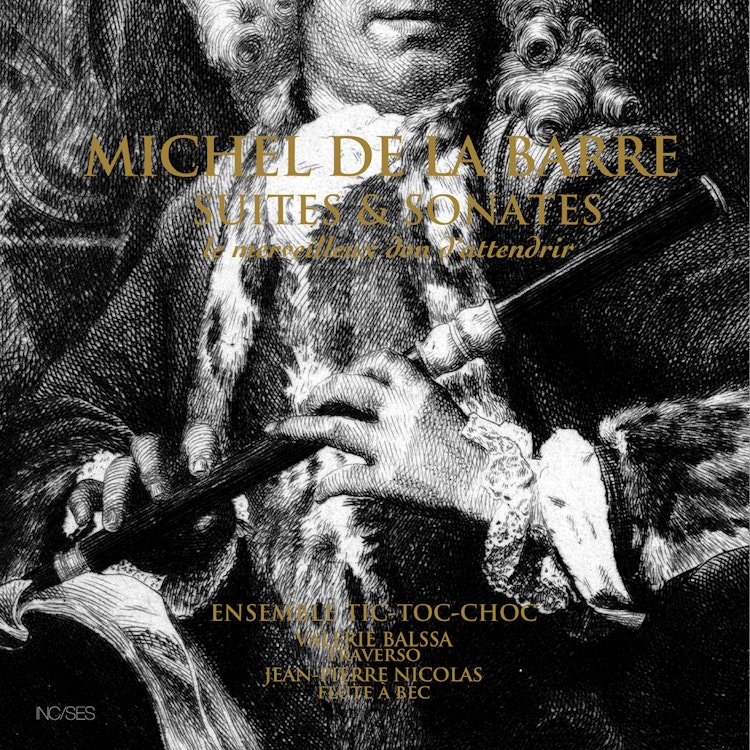
Michel de La Barre's 1702 collection of pieces for transverse flute and basso continuo was presented as the first ever published for this type of flute.
Interpretation
This recording uses 'tempérament ordinaire', a tuning system common in France in 1726, which allows for varied emotional effects from different intervals.
Interpretation
Michel de La Barre himself advised that for accompaniment, a bass viol and a theorbo or harpsichord (or both) should be used, preferring the theorbo for its gut strings' sound with the transverse flute.
Instruments
The album features both the transverse flute and the recorder, reflecting a historical period when both instruments coexisted, despite their differing characteristics.
Composer's Artistic Vision
Michel de La Barre sought to exploit the full expressive potential of the transverse flute, favoring the low-medium register for its round, idiomatic, and sensual sounds.
Performer Biography
Valérie Balssa, the traverso player, studied baroque flute with Barthold Kuijken, an undisputed master of the instrument, and performed with William Christie's Les Arts Florissants.
Composer Biography
Michel de La Barre, the composer, is considered the founder of the French school of transverse flute due to his pioneering work for the instrument.
You might also enjoy...
Harpeklang i Vinternatt
L'Occitanie baroque des pénitents noirs
Volkslied Reloaded
Love From King's
Bach: The Cello Suites - Recomposed by Peter Gregson