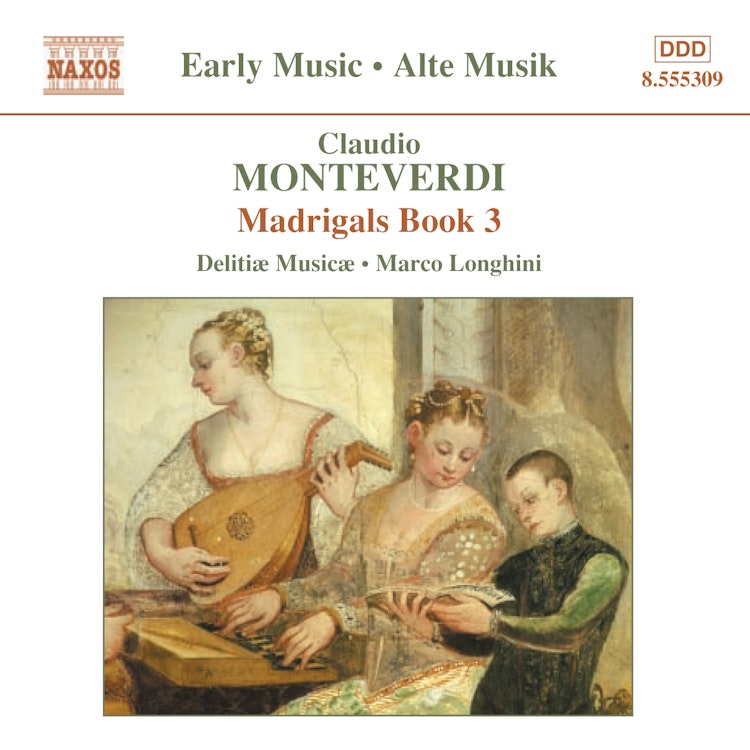
Monteverdi, C.: Madrigals, Book 3 (Il Terzo Libro De' Madrigali, 1592)
7/18/2004, 20 Tracks, 1:09:04
Featuring
Marco Longhini
Delitiæ Musicæ
Claudio Monteverdi
Did you know?
1/7
Performer Biography
Delitiae Musicae, established in 1992, is considered one of the most interesting Italian early music ensembles, known for its plausible reconstructions of a cappella music from the Italian Renaissance.
Composer Biography
By 1592, Monteverdi was working as a composer at the Mantuan court alongside Giaches de Wert, the maestro di cappella, whom he hoped to succeed.
Historical Context
Some madrigals in this book may have been written for the Concerto delle Dame di Ferrara, an all-female group of noblewomen and singers renowned for their virtuosity in Renaissance Italy.
Composer's Artistic Vision
Monteverdi dedicated his Third Book of Madrigals to Duke Vincenzo Gonzaga, offering what he called 'mature and tasty fruit' that would appeal to the cultural atmosphere of the time.
Composition History
Monteverdi's Third Book of Madrigals, published in Venice in 1592, was his first major success and sold extremely well, with five reprints before 1611.
Compositional Technique
The Third Book of Madrigals is an innovative and at times revolutionary work, influenced by the artistic splendours of the Mantuan court, featuring bold expressive elements.
Interpretation
This recording features an all-male cast of singers, based on historical research suggesting that madrigals were commonly performed by men only at the Mantuan court and throughout Italy during Monteverdi's time.
You might also enjoy...
Monteverdi, C.: Madrigals, Book 2 (Il Secondo Libro De' Madrigali, 1590) (La Venexiana)
Monteverdi, C.: Madrigals, Book 2 (Il Secondo Libro De' Madrigali, 1590)
Monteverdi: Quarto Libro di Madrigali
Monteverdi: Il quarto libro dei madrigali
Monteverdi: Il sesto libro de madrigali
Prima le parole: Partitura de' madrigali a cinque voci