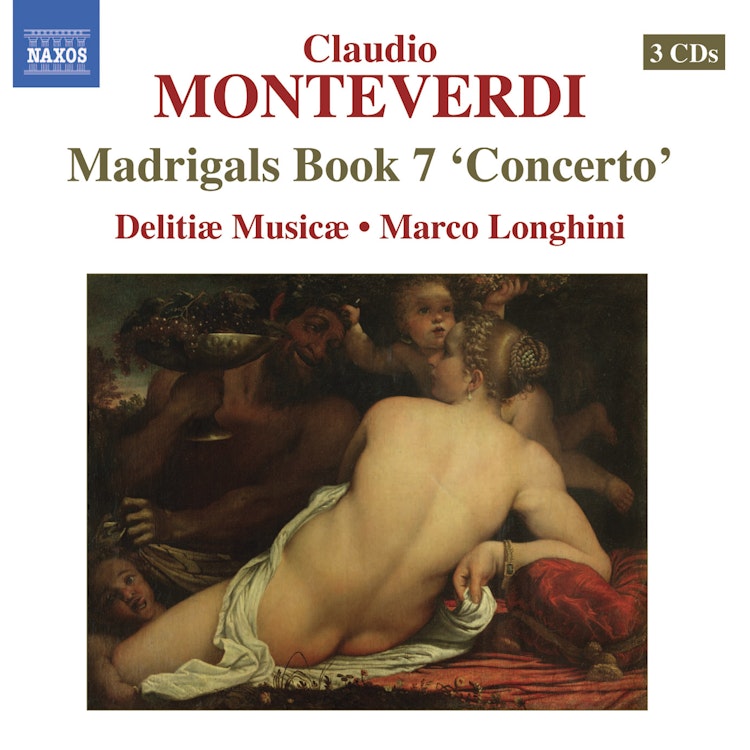
Monteverdi, C.: Madrigals, Book 7, "Concerto" (Il Settimo Libro De Madrigali, 1619)
3/30/2009, 46 Tracks, 2:42:02
Featuring
Marco Longhini
Delitiæ Musicæ
Claudio Monteverdi
Did you know?
1/7
Recording & Production
This recording uses a new complete critical edition of Monteverdi's Seventh Book of Madrigals, prepared by Marco Longhini, which corrects errors found in previous editions.
Composition History
Claudio Monteverdi's Seventh Book of Madrigals, titled 'Concerto', was published in Venice in 1619, five years after his Sixth Book.
Interpretation
The ensemble Delitiæ Musicæ and director Marco Longhini follow Monteverdi's original arrangement of pieces in the Seventh Book, believing it is fundamental to understanding his 'carefully calculated and finely balanced' artistic vision.
Composer's Artistic Vision
The title 'Concerto' for Monteverdi's Seventh Book reflects its heterogeneous nature, pointing to contrasts and harmony between parts, voices, and instruments.
Compositional Technique
Monteverdi's Seventh Book of Madrigals represents a clear break from his earlier works, featuring no five-voice madrigals but rather pieces for one to four voices, often with basso continuo and violins, and experimental forms.
Historical Context
Monteverdi moved from Mantua to Venice in 1614, embracing Venice's innovative culture and political autonomy as a Republic, which offered a new compositional direction away from court life.
Composer Biography
Monteverdi dedicated his Seventh Book of Madrigals to Catherine de' Medici, daughter of the rulers of Florence, to maintain good relations with Ferdinando Gonzaga, Duke of Mantua.
You might also enjoy...
Monteverdi: Il quarto libro dei madrigali
Padilla, J.G. De: Maitines De Natividad (1652) (Mexican Baroque, Vol. 7)
Monteverdi, C.: Madrigals, Book 2 (Il Secondo Libro De' Madrigali, 1590) (La Venexiana)
Monteverdi: Settimo Libro de Madrigali
Madrigali in genere rappresentativo
Monteverdi, C.: Madrigals, Book 3 (Il Terzo Libro De' Madrigali, 1592) (La Venexiana)
Monteverdi: Quinto libro dei madrigali
Mazzaferrata: Canzonettas & Cantatas for 2 Voices, Op. 3