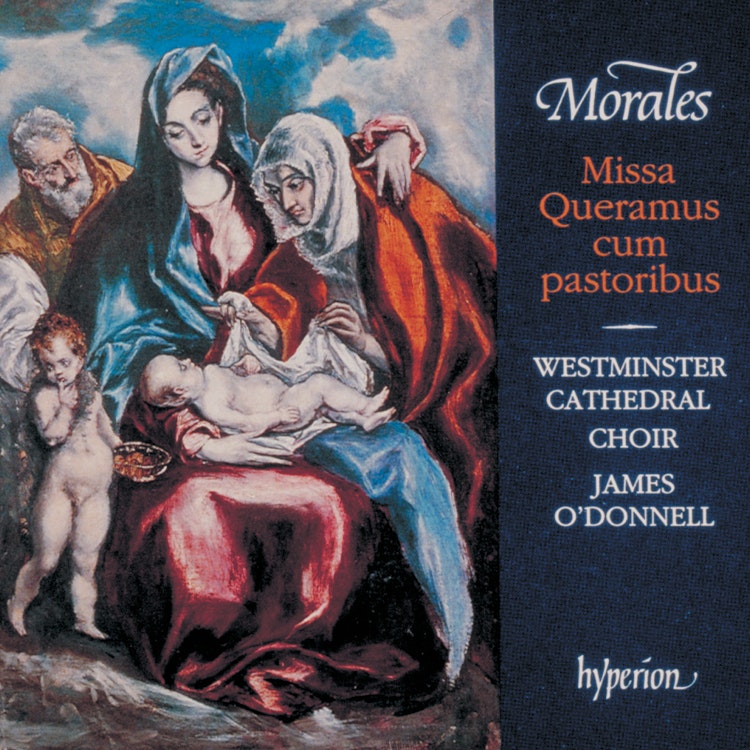
Morales: Missa Queramus cum pastoribus & Other Sacred Music
11/24/2023, 12 Tracks, 1:05:23
Featuring
James O'Donnell
Westminster Cathedral Choir
Cristóbal de Morales
Jean Mouton
Did you know?
1/7
Composition History
Morales's motet O sacrum convivium, likely from his Roman period, served as a model for Palestrina's Missa O sacrum convivium, indicating its unusual polyphony was admired by other distinguished composers.
Compositional Technique
Morales's Missa Queramus cum pastoribus is scored for five voices with divided basses, an unusual choice that allowed him to explore rich, dense textures not present in Mouton's original four-part motet.
Compositional Technique
Morales's Mass transforms Mouton's concise motet into expansive music, with almost every moment of the Mass based on the motet, but rarely through straightforward quotation.
Composer Biography
Cristóbal de Morales, born around 1500 in Seville, spent most of his life serving Spanish cathedrals, but also worked in Rome as a singer in the papal choir.
Composition History
Morales based his Missa Queramus cum pastoribus on a popular Christmastide motet by French composer Jean Mouton, which was sung by the papal choir.
Compositional Technique
Morales's metamorphoses of Mouton's motet are so ingenious and obscure that they may be missed by a casual listener, revealing more with repeated hearings.
Composer's Artistic Vision
Morales's music has a cosmopolitan quality, transcending nationality, unlike his compatriot Tomás Luis de Victoria, whose music is considered quintessentially Spanish.
You might also enjoy...
The Earth Resounds
The Call of Rome
Victoria: Requiem Mass; O Magnum Mysterium; Ave Maria
Taverner: Missa Sancti Wilhelmi & Other Sacred Music
De la Rue: Missa de Sancta Cruce; Salve regina
Masters of Imitation
How Excellent Is Thy Name: Sacred Music of Lassus
Choral Recital: Monteverdi Choir - Morales / Victoria, T.L. / Clements Non Papa / Mouton (Pilgrimage To Santiago)
Josquin Des Prez: Messe "Pange lingua" & Miserere
Tomás Luis de Victoria: Requiem "Officium defunctorum"