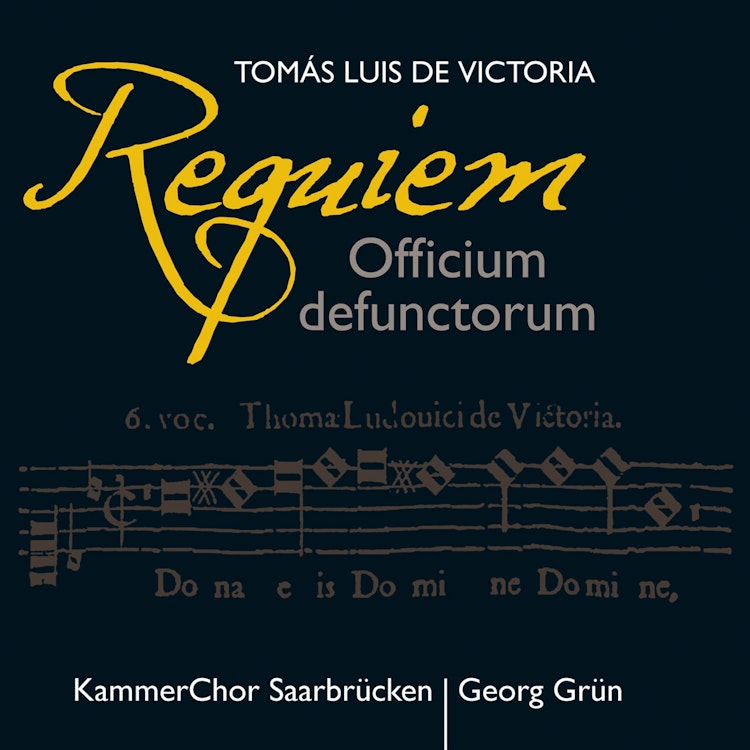
Tomás Luis de Victoria: Requiem "Officium defunctorum"
9/6/2012, 13 Tracks, 57:52
Featuring
Georg Grün
KammerChor Saarbrücken
Tomás Luis de Victoria
Did you know?
1/7
Performer Biography
The KammerChor Saarbrücken, founded in 1990 by Georg Grün, is one of Germany's most renowned choirs, with numerous international performances and critically acclaimed CD recordings, including a Midem Classical Award.
Composer's Artistic Vision
In his Officium defunctorum, Tomás Luis de Victoria deliberately omitted the dramatic Dies Irae sequence, instead focusing on the pastoral and hopeful aspects of the liturgy for the deceased.
Historical Context
The Council of Trent (1545-1563) was the Catholic Church's response to Martin Luther's Reformation, leading to reforms in church music that emphasized text clarity, dignity, and adherence to counterpoint rules.
Composer's Artistic Vision
Tomás Luis de Victoria's music, particularly his Officium defunctorum, exemplifies the Council of Trent's reforms by adhering to traditional Renaissance counterpoint and incorporating Gregorian chant.
Composition History
Tomás Luis de Victoria composed his Officium defunctorum for the memorial services of Maria of Austria, the Holy Roman Empress, in 1603, two years before its publication.
Composer Biography
Tomás Luis de Victoria was sent to Rome as a scholar of Spanish King Philipp II and later became the successor to Giovanni Pierluigi da Palestrina as musical director of the Collegium Germanicum's chapel.
Composer Biography
Tomás Luis de Victoria, considered the greatest Spanish composer of his era, was born around 1548 in Ávila, Spain, and his entire life and work were dedicated to the Catholic Church.
You might also enjoy...
Palestrina: Missa Papae Marcelli & Missa brevis
Byrd: Infelix ego
Victoria: Missa "Vidi Speciosam"; Motet "Vidi Speciosam"; Responsorium IV; Motet "O Domine Jesu Christe"; Responsorium IV; Responsorium VI; Lectio III; Responsorium IX; Motet "Dum Complerentur"; Motet "Surrexit Pastor Bonus"
Byrd and his Contemporaries
Byrd: Motets
Roma æterna
Byrd: Mass in 5 Parts; Magnificat & Nunc Dimittis
The Golden Renaissance: William Byrd
Gesualdo: Sacrae Cantiones Liber secundus
Josquin Des Prez: Messe "Pange lingua" & Miserere
Byrd: Laudibus in sanctis & Other Sacred Music (Byrd Edition 10)
Victoria: Missa Trahe me post te & Other Sacred Music