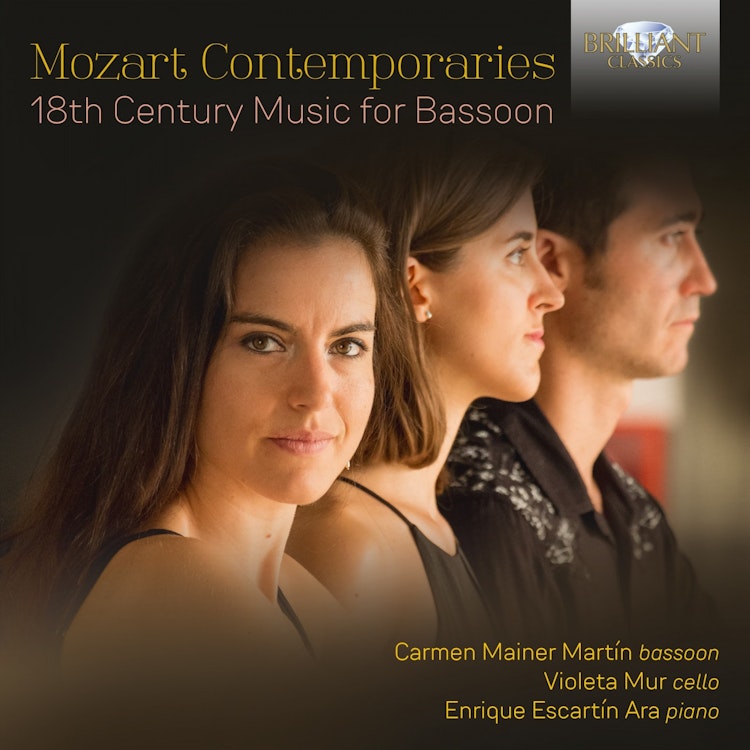
Mozart Contemporaries: 18th Century Music for Bassoon
1/29/2021, 15 Tracks, 58:14
Featuring
Carmen Mainer Martín
Violeta Mur
Enrique Escartín Ara
François Devienne
Thaddaus Wolfgang von Durnitz
Wolfgang Amadeus Mozart
Did you know?
1/6
Compositional Technique
Thaddäus Wolfgang von Dürnitz, an amateur composer and bassoonist, explored the technical capabilities of the 18th-century bassoon in his sonatas by frequently venturing into the instrument's upper register, a novelty at the time.
Instruments
The 18th-century Classical bassoon, used by composers like Dürnitz, evolved from the Baroque bassoon with significant refinements, including added keys that expanded its technical capabilities and range, especially in the upper register.
Interpretation
The performers chose the bassoon-cello pairing for François Devienne's Duos Concertants Op.3 to maintain coherence with Mozart's Sonata in B flat and for the rich tone and color of this combination of two low instruments.
Performer Biography
Carmen Mainer Martín, the bassoonist on this album, won the Performance Prize from the Colegio de España in Paris in 2015, which enabled her to record her first solo album.
Composition History
Mozart's Sonata for bassoon and cello in B flat, KV292, was written around 1775, when Mozart was not yet twenty, and was dedicated to the music-loving nobleman Thaddäus Wolfgang von Dürnitz.
Album & Artwork
This album features works by three composers born in the 1750s, all writing in the Classical idiom of 18th-century Europe, with a focus on the bassoon.
You might also enjoy...
Works for Bassoon & Organ
Beethoven: Works for Guitar & Piano
The Richard Strauss Project: Complete Works for Piano Solo, Vol. 1