Mozart was uninterested in politics, unlike his father, but was deeply interested in the nature of those who enact political ideas or suffer their consequences.
Compositional Technique
Lorenzo da Ponte removed Figaro's politically inflammatory tirade from Beaumarchais's play, replacing it with a disquisition on cuckoldry, which Mozart's music then deepened and humanised.
Historical Context
In 1780s Vienna, where Joseph II's government was more liberal, Mozart could buy the play Die Hochzeit des Figaro but was not allowed to perform it.
Composer Biography
Lorenzo da Ponte, the librettist for Le nozze di Figaro, was born Emmanuele Conegliano, the son of a Jewish tanner, and trained for the priesthood before fleeing Dresden due to scandals.
Critical Reception
Le nozze di Figaro did not flop in Vienna; an imperial decree was issued within two weeks of its premiere, limiting encores and banning the encoring of numbers for more than one voice.
Composition History
Beaumarchais's play, Le mariage de Figaro, was initially banned by Louis XVI in 1781, who declared, 'That will never be played.'
Performer Biography
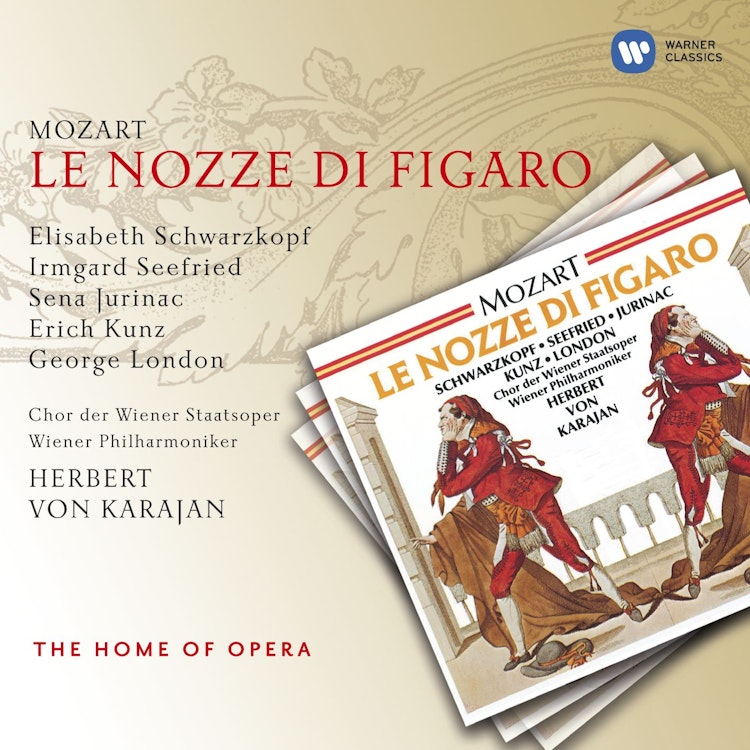
Le nozze di Figaro was the first opera Herbert von Karajan ever conducted, in Ulm in March 1929, a few days before his twenty-first birthday.
You might also enjoy...
Giordano: Andrea Chenier (1958)
Pavarotti – The Opera Collection 7: Verdi: Luisa Miller
Schönberg: Moses und Aron
Verdi: Rigoletto
Donizetti: Poliuto (1960 - Milan) - Callas Live Remastered
Bellini: I puritani (1953 - Serafin) - Callas Remastered