The discovery of Mozart's original manuscript for K. 331 revealed that previous critical editions, based on a 1784 publication, contained significant differences in dynamics, rhythm, and notes.
Composition History
In September 2014, a previously lost double leaf of Mozart's own notation for his Piano Sonata in A Major, K. 331, was discovered in Budapest.
Compositional Technique
The final movement of Mozart's A-Major Sonata, K. 331, known as the Turkish March, was inspired by Janissary music, the military music of the Ottomans, featuring rapid arpeggios that imitate Turkish instruments.
Performer Biography
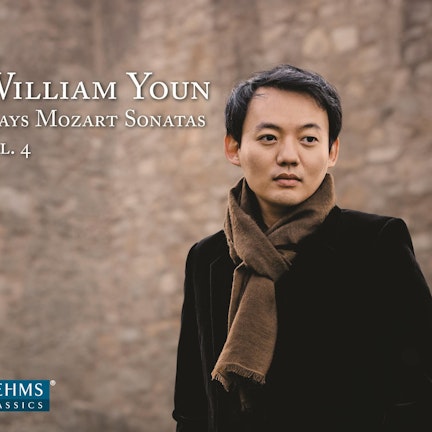
William Youn, a Korean pianist born in 1982, was a pupil of renowned piano pedagogue Karl-Heinz Kämmerling and has performed in world-renowned halls and international festivals.
Composition History
Mozart's A-Major Sonata, K. 331, was composed in Salzburg or Vienna in 1783, not in Paris in 1778 as long believed, a fact determined by inspecting the manuscript paper.
Composition History
Mozart's Sonata in F Major, K. 533/494, developed in reverse order: he first composed a 'little Rondo for the piano alone' in 1786, and then decided in 1788 to make it part of a new sonata by adding two earlier movements and a 27-bar section to the rondo.
Recording & Production
Approximately one-third of the music on this CD was recorded live during William Youn's concert at Schloss Elmau on June 24, 2015.
You might also enjoy...
Mozart the Poet: Piano Sonatas, Vol. 4
Mozart: Complete Piano Sonatas, Vol. 3
Mozart: Piano Sonatas K.283, K.284 & K.330
Mozart: Piano Works, Vol. 4. Piano Sonatas, K. 279 - 284