It was long believed that Mozart composed the Serenade in 1780 or 1781 for a performance in Munich, due to the Munich Hofkapelle's renowned wind players.
Historical Context
The Serenade follows a tradition of multi-movement, light-hearted works for various instrument combinations, often performed by musicians outside a lover's window.
Compositional Technique
The Serenade K361 is often erroneously referred to as 'Serenade for thirteen wind instruments' because it is frequently performed with a double bassoon instead of the string double bass specified by Mozart.
Composition History
Modern scholarship, particularly from the Neue Mozart-Ausgabe, suggests the Serenade was composed in 1784 for a benefit concert for Anton Stadler, a gifted wind player in Vienna.
Historical Context
The Harmoniemusik, a wind octet established by Emperor Joseph II in 1782, became a popular form of musical entertainment in the 1780s and 1790s, with many composers writing for it.
Composition History
The Serenade in B flat, K361, has been the subject of many contradictory theories regarding its composition history, with its origins long shrouded in mystery.
Recording & Production
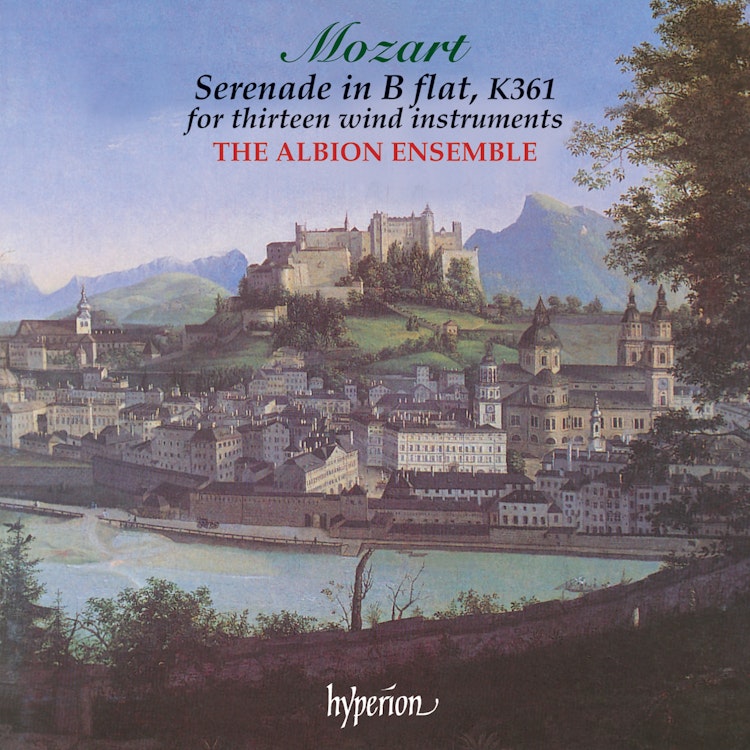
For this recording, The Albion Ensemble returned to Mozart's autograph score, using a facsimile edition and the Neue Mozart-Ausgabe to clarify inconsistencies.
You might also enjoy...
Mozart: Serenade in B-flat Major, K.361 (370a) "Gran Partita"
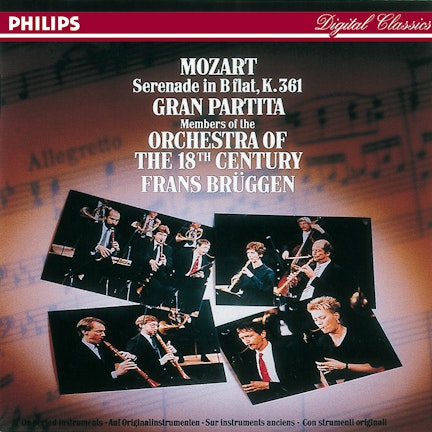
Gran Partita
Mozart: Serenade K.361 "Gran Partita"
Mozart: Serenade, K. 361 "Gran partita"
Mozart: Serenade No. 10 "Gran Partita"
Mozart: Gran Partita
Wolfgang Amadeus Mozart: Serenade in C Minor, K.388
Mozart: Gran Partita, Sérénade No. 12 "Nacht Musique" K. 388
Mozart: Serenade No. 10 in B-Flat Major, K. 361 "Gran Partita"
Mozart: Serenade No. 10 in B-Flat Major, K. 361, "Gran Partita"
Mozart: Serenade No.10, "Gran partita"
Mozart: Serenade No. 10 in B-Flat Major, K. 361 "Gran Partita"
Mozart : Serenade No.10 in B flat major, 'Gran Partita'