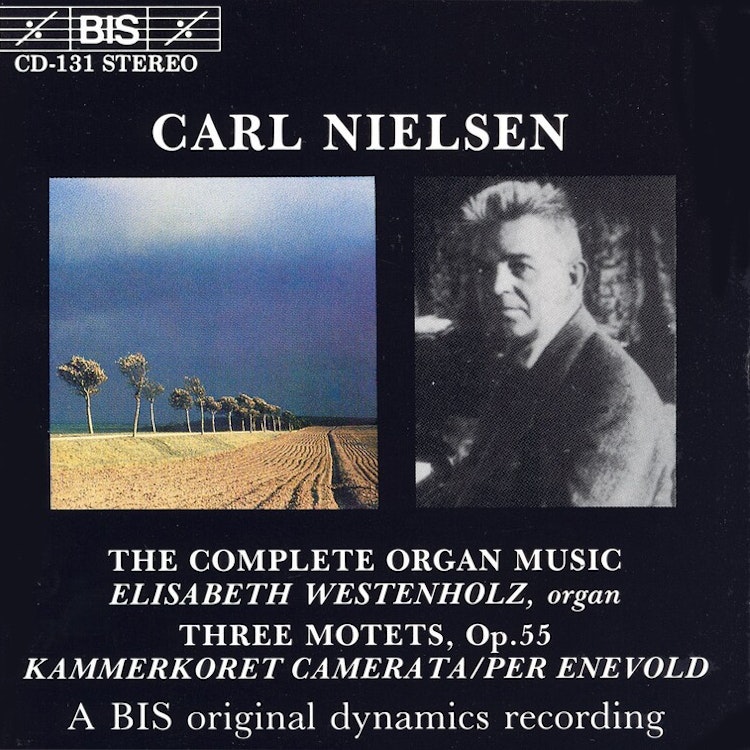
The great organ at Grundtvig's church, played by Elisabeth Westenholz on this recording, was built in 1965 by Marcussen & Son and is unique in the Nordic countries for having a 32' Principal in its facade, which can be heard in Commotio.
Compositional Technique
Carl Nielsen, the composer, described his major organ work Commotio as an attempt to reconstruct the "one and only true organ style," focusing on polyphonic music specially suited to the instrument, which he felt was often wrongly regarded as a sort of orchestra.
Composer's Artistic Vision
For his Three Motets, Carl Nielsen, the composer, chose to retain the Latin translations of the Psalms, as the old masters had done, and aimed to model himself on them rather than imitate them.
Composer's Artistic Vision
Carl Nielsen, the composer, was fascinated by Renaissance and Baroque polyphony, which influenced his later works, including the organ music and a cappella choir pieces on this album.
Composition History
Nielsen's 29 small Preludes for organ or harmonium were written in rapid succession in early 1929 after a request from Johannes Hansen, whose brother-in-law, Thorvald Aagaard, had just published similar preludes.
Composition History
The Three Motets were composed in a period of intense work in summer 1929, after Carl Nielsen, the composer, studied scores by Palestrina and old Dutch masters lent to him by Mogens Woldike, the conductor of the Palestrina Choir.
Composer's Artistic Vision
Carl Nielsen, the composer, stated that in a major work for the organ, like Commotio, the composer must suppress personal, lyrical feelings, demanding a "sobriety" to be examined by the ear rather than embraced by the heart.
You might also enjoy...
Guilmant Garnishes
Lemare: Organ Transcriptions
Guilmant: Organ Works
Music for a Grand Organ
Music For A Grand Organ
Viennese Reflections
The Complete Alkan Organ Works: Vol. 1
Debussy & Ravel: Works Arranged for Organ
Organ Recital: Briggs, David - Briggs, D. / Walton, W. / Faure, G. / Nevin, G.B. / Vierne, L. / Reubke, J. (Organ Spectacular)
Great European Organs, Vol. 90
Hakim / Langlais / Litaize: Organ Music
Organ Recital: Nolan, Joseph – Boellmann, L. / Elgar, E. / Thalben-Ball, G. / Liszt, F.
The Britannic Organ, Vol. 7
Organ Recital: Turk, Gordon - Boellman, L. / Vierne, L. / Salome, T. / Guilmant, A. / Widor, C.-M. / Lefebure-Wely, L. / Mulet, H. (Ocean Grove)