The Welte Philharmonie system, used for these recordings, allowed for the capture and reproduction of organ performances from 1911 onwards in Freiburg im Breisgau.
Interpretation
Karl Matthaei, a Swiss organist, significantly influenced the Welte firm to adapt to the 'Organ Reform Movement,' shifting recordings towards earlier music and away from late Romanticism.
Performer Biography
Johann Jakob Nater, a Swiss organist, was one of Welte's most prolific recording artists, amassing 100 player rolls, more than any other organist except Harry Goss-Custard.
Performer Biography
Swiss organists, like those featured on this album, often studied with prominent figures such as Karl Straube in Leipzig, Alexandre Guilmant in Paris, or Joseph Rheinberger in Munich.
Historical Context
Switzerland's neutrality during the two World Wars allowed for an uninterrupted and long-standing organ culture, influenced by surrounding cultural centers.
Instruments
The album features recordings made on Welte Philharmonie organs, including one originally intended for the SS Britannic ocean liner, sister ship of the Titanic.
Compositional Technique
Franz Joseph Breitenbach, a Swiss organist and composer, was part of a generation that perpetuated 'Orage' traditions, programmatically representing storms in organ music.
You might also enjoy...
Reger, M.: Organ Works, Vol. 8
French Accent
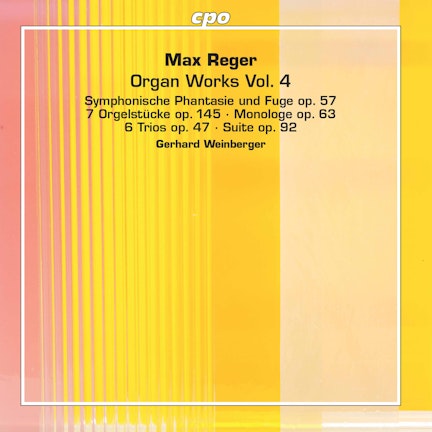
Reger: Organ Works, Vol. 4
Stanford: The Complete Organ Works, Vol. 5
Dupré: Complete Organ Works Vol. 6
Freu dich sehr, o meine Seele
Axel Ruoff: Complete Works for Organ, Volume Four
Reger, M.: Organ Works, Vol. 5
Schoenberg: Variations on a Recitative - Reger: Benedictus - Variations on an Original Theme