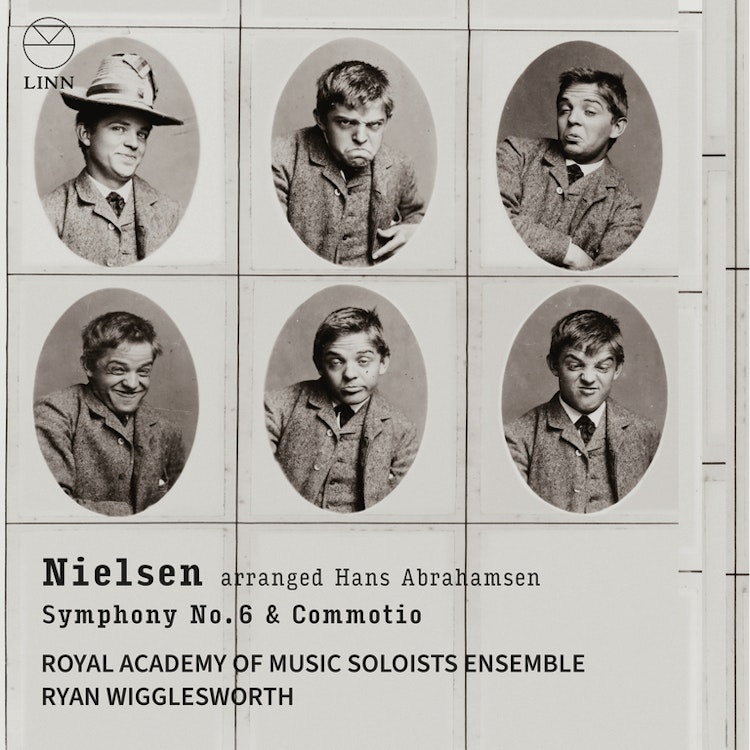
Nielsen: Symphony No. 6 & Commotio (Arr. by Hans Abrahamsen)
9/5/2025, 8 Tracks, 58:37
Featuring
Ryan Wigglesworth
Royal Academy of Music Soloists Ensemble
Carl August Nielsen
Did you know?
1/7
Interpretation
Hans Abrahamsen, a fellow-Dane, arranged Nielsen's Symphony No. 6 and Commotio to distil the original scores with sharpened commentaries, colors, and affirmations of Nielsen's distinctive language.
Composer's Artistic Vision
For Commotio, Nielsen's model was the organ music of the German Baroque, particularly composers like Dietrich Buxtehude and J. S. Bach, and he believed its severe contrapuntal style was the only valid way to write for the instrument.
Composition History
Carl Nielsen, the composer of Symphony No. 6 and Commotio, knew his life would be shortened by a serious heart condition, yet he embarked on bold compositional discoveries in his final years.
Compositional Technique
Nielsen's Symphony No. 6, subtitled 'Sinfonia semplice', has been viewed as pessimistic by some due to its ironic tone, with its finale compared to a grinning skeleton by composer Robert Simpson.
Interpretation
Hans Abrahamsen's transcription of Nielsen's Symphony No. 6 significantly reduces the original orchestration, cutting double winds almost in half and reducing ten brass instruments to a trio, while adding piano and harmonium.
Interpretation
Hans Abrahamsen's arrangement of Commotio uses eighteenth-century horns and trumpets with natural tuning, and period timpani played with mallets, to nod towards the roots of Nielsen's composition and the practice of transcription.
Composition History
Commotio for organ was Nielsen's last major work, completed in February 1931, and its public premiere in Aarhus was attended by Nielsen, who died three days before a subsequent performance became an impromptu tribute.
You might also enjoy...
Rubinstein: Symphony No. 6
Rachmaninoff: Symphony No. 2 in E Minor, Op. 27 & Vocalise, Op. 34 No. 14 (Remastered 2023)
Schmidt: Symphony No. 4 - Variations on a Hussar's Song
Rachmaninov: Symphony No. 2 - Vocalise
Brahms: Symphony No. 2 in D Major, Op. 73 & Variations on a Theme by Haydn in B-Flat Major, Op. 56a
Berlioz: Symphonie fantastique; Lili Boulanger: D'un soir triste
Steinberg: Symphony No.2; Variations Op.2
Rachmaninov: Symphony No. 3 / Melodie in E / Polichinelle