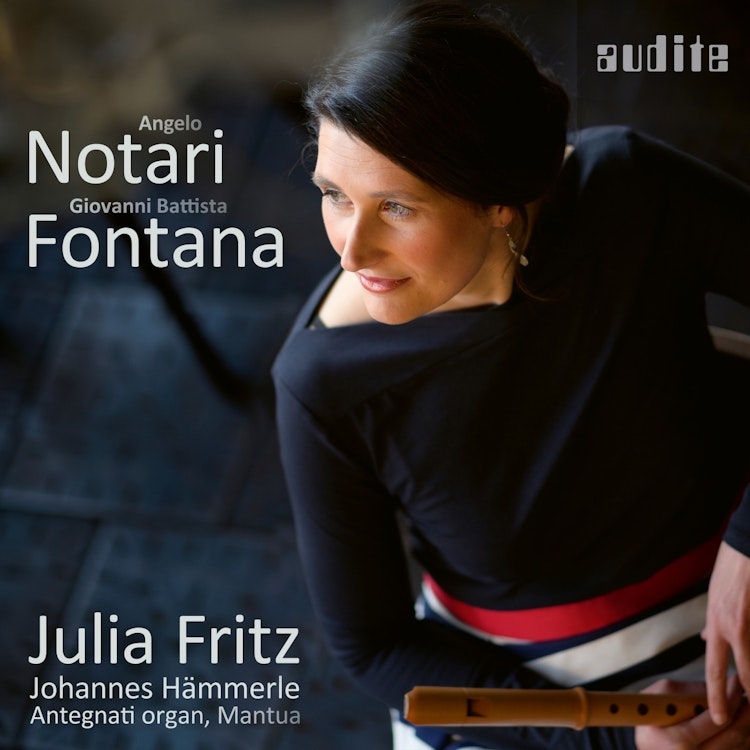
Notari & Fontana (Early Baroque Music from the Basilica di Santa Barbara, Mantua)
7/2/2021, 15 Tracks, 1:12:33
Featuring
Johannes Hämmerle
Julia Fritz
Reinhild Waldek
Magdalene Harer
Giovanni Battista Fontana
Angelo Notari
Francesco Rovigo
Did you know?
1/7
Composer Biography
Giovanni Battista Fontana, whose sonatas are featured, came from Brescia and worked in Rome, Venice, and Padua, where he likely died during the devastating plague epidemic of 1630.
Historical Context
Mantua, where some of the music on this album was composed and recorded, was a place of innovation and experimentation, fostered by the cosmopolitan Gonzaga dynasty.
Instruments
The album features a Renaissance organ in the Basilica Palatina di Santa Barbara in Mantua, completed in 1565 by Graziadio Antegnati, which is one of Italy's most important surviving Renaissance organs.
Compositional Technique
The Antegnati organ has special features like split keys for enharmonic notes, which allowed for fine tuning in the meantone temperament, favoring pure thirds for a melodious sound.
Interpretation
Recorder player Julia Fritz uses her own collection of historical recorders, which are specifically chosen to match the pitch and meantone tuning of the Antegnati organ in Santa Barbara.
Composer Biography
Angelo Notari, one of the composers featured, was an Italian musician who relocated to England in 1610 and served as court musician to King Charles I.
Composition History
A manuscript in the British Library (Add. Ms. 31440), believed to be penned by Angelo Notari, contains works by Notari and his contemporaries, including arrangements of vocal pieces by Claudio Monteverdi.