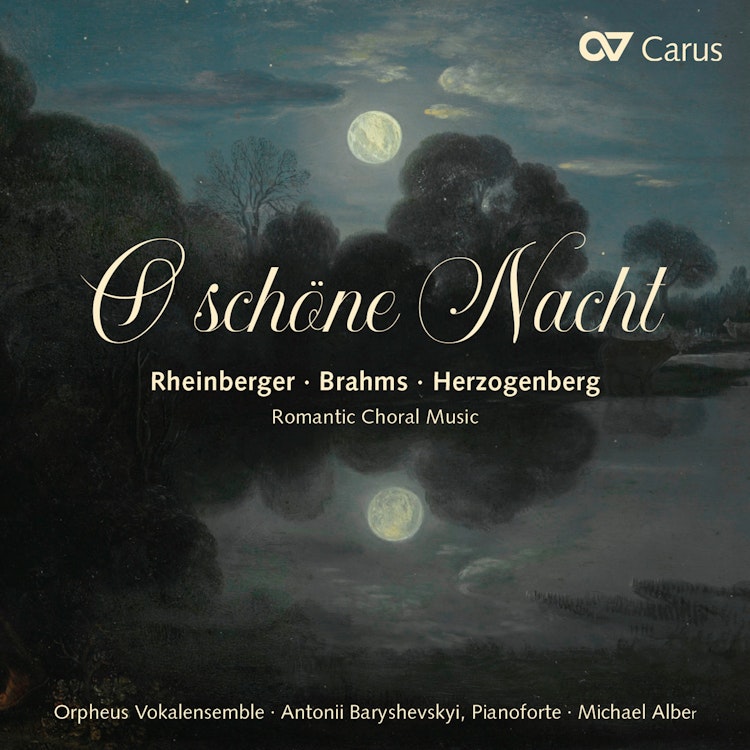
Romantic choral works by three 19th-century composers paint a mystical, poetic picture of nature, often in the moonlit night. Alongside several vocal quartets by Brahms are works by two contemporaries of his: the Austrian Heinrich von Herzogenberg and the German Josef Gabriel Rheinberger – whose four songs are recorded here for the very first time. The Orpheus Vocal Ensemble is directed by Michel Alber.
Featuring
Antonii Baryshevskyi
Michael Alber
Orpheus Vokalensemble
Josef Gabriel Rheinberger
Heinrich Peter Freiherr von Herzogenberg
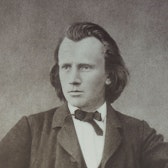
Johannes Brahms
Did you know?
1/7
Performer Biography
Antonii Baryshevskyi, the pianist on this recording, won first prize at the 14th International Arthur Rubinstein Piano Competition in 2014 and second prize at the Busoni Piano Competition in 2011.
Composition History
Brahms's O schöne Nacht, op. 92, No. 1, was sent to Elisabeth von Herzogenberg, the wife of composer Heinrich von Herzogenberg, with a provocative note regarding its erotic text, referencing her earlier criticism of another Brahms song.
Historical Context
The rise of the educated middle class in European cities from the late 18th century fostered a passionate interest in cultural activities, leading to the creation of literary and musical salons and singing academies.
Composition History
Josef Gabriel Rheinberger's choral song Harald op. 106,1 was inspired by Ludwig Uhland's 1810 ballad of the same name, which tells the story of Harald's army being enchanted by fairies.
Performer Biography
Michael Alber, the conductor, was the choir director of the Staatsopernchor Stuttgart from 1993 to 2012, during which time the choir was named 'Opera Choir of the Year' nine times.
Composer's Artistic Vision
The 'ballade' genre, popular since the late 18th century, was ideal for musical settings, helping to shape national identity through sagas and myths, and countering the 'disenchantment of nature' by invoking a mysterious world of elves and mermaids.
Compositional Technique
Brahms incorporated the piano prelude of Heinrich von Herzogenberg's Notturno op. 22, No. 2, into his own quartet O schöne Nacht, op. 92, No. 1, adapting Herzogenberg's motif to represent the nightingale's song.
You might also enjoy...
O schöne Nacht. Romantische Chormusik
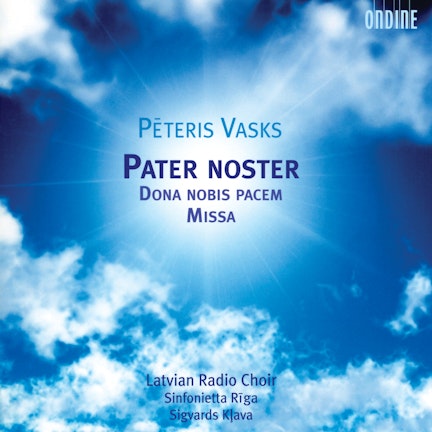
Vasks: Pater Noster, Dona Nobis Pacem, Missa
Vasks, P.: Pater Noster / Dona Nobis Pacem / Mass
Schubert: Voices in the Night - Choral Works
Werke für Männerchor von Schubert, Kreutzer, Gluck, Mendelssohn, Abt, Schumann
Rautavaara, E.: Choral Music for Male Choir (Complete)
Brahms: Liebeslieder Waltzes & Evening Songs
Testament
Brahms: Liebeslieder
Britten: A Boy Was Born; Rejoice in the Lamb; Festival Te Deum
Sibelius, J.: Partsongs / Vapautettu Kuningatar / Rakastava / Laulu Lemminkaiselle (Yl Male Voice Choir)
Ireland: Church Music
Rutter: Feel the Spirit / Birthday Madrigals / Shearing: Songs and Sonnets From Shakespeare