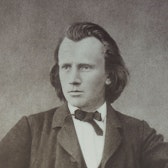
Johannes Brahms's 'O schöne Nacht' (op. 92, no. 1) was sent to Elisabeth von Herzogenberg with a playful, self-critical note about its erotic implications, and it incorporates a piano prelude from Heinrich von Herzogenberg's 'Notturno' op. 22,2.
Composer's Artistic Vision
The composers on this album, Rheinberger, Brahms, and Herzogenberg, wrote secular ensemble music with piano accompaniment in the second half of the 19th century, continuing the tradition of setting poetry to music.
Performer Biography
Antonii Baryshevskyi, the pianist on this recording, is a concert soloist of the National Philharmonic of Ukraine and won first prize at the 14th International Arthur Rubinstein Piano Competition in 2014.
Composition History
The 'ballade' genre, popular since the late 18th century, was still a significant form for musical settings, helping to shape national identity through sagas and myths, and invoking a mysterious world of mythical creatures.
Performer Biography
Michael Alber, the conductor, was the choir director of the Staatsopernchor Stuttgart for nearly two decades, during which time the choir was named 'Opera Choir of the Year' nine times.
Compositional Technique
Josef Gabriel Rheinberger's choral works, such as Mummelsee and Harald, are inspired by German folklore, featuring elves, mermaids, and other mythical beings.
Historical Context
The rise of the educated middle class in European cities from the late 18th century fostered a passionate interest in cultural activities, leading to the creation of literary and musical salons and singing academies.
You might also enjoy...
O schöne Nacht: Romantic Choral Music
Alfred Janson: The Wind Blows
Testament
Grainger & Grieg: At Twilight & Other Choral Works
Warlock: Choral Music
Vecchia: Sacred Works
Danish Partsongs
Mariengesänge des 19. Jahrhunderts
Dialogue
Janáček: Říkadla
Messiaen: 5 Rechants / Jolivet: Epithaleme / Debussy: 3 Chansons De Charles D'Orleans