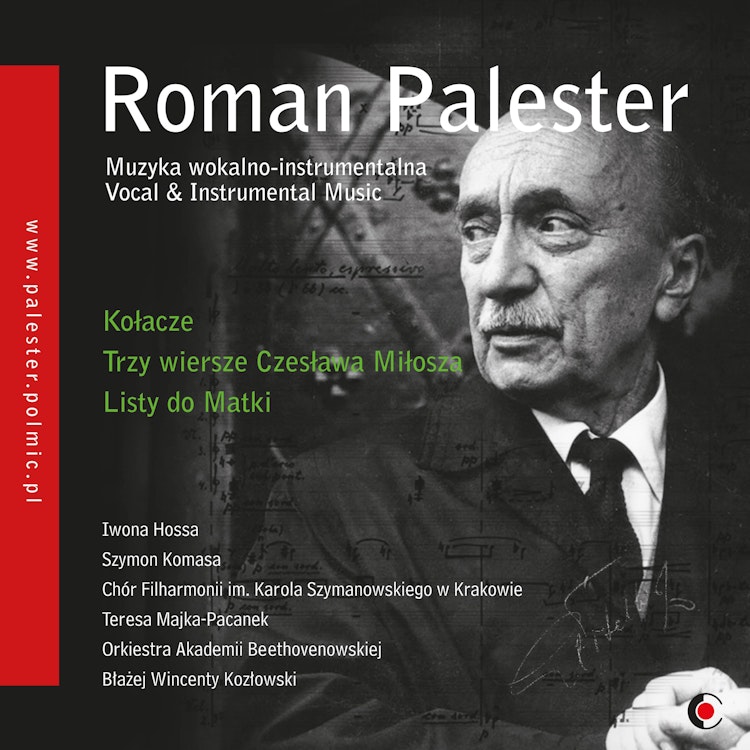
This recording marks the phonographic premiere of Roman Palester's "Trzy wiersze Czesława Miłosza" (Three Poems by Czesław Miłosz) and "Listy do Matki" (Letters to the Mother).
Historical Context
After announcing his decision to emigrate in 1950, Roman Palester was declared persona non grata in Poland, leading to his music being rarely performed or published.
Composer's Artistic Vision
Roman Palester considered "Kołacze" his first conscious attempt to define a "Polish style" in music, a search he continued in later works like "Polonezy Ogińskiego" and "Wisła."
Composer Biography
Roman Palester (1907-1989), a man of great erudition, worked for twenty years (1952-1972) as head of the culture department at Radio Free Europe.
Compositional Technique
In "Kołacze," Roman Palester blended elements of old Polish verbal language with contemporary musical sounds, creating a unique encounter of old and new.
Compositional Technique
In "Listy do Matki," Roman Palester used a characteristic three-note motif (G sharp-B-G), which he interpreted as a "death motif," previously appearing in his "Treny" and "Espressioni."
Composition History
The work "Kołacze" (The Wedding Cake) was composed in 1942 as a wedding gift for Roman Palester's wife, Barbara Podoska, and is based on a Baroque epithalamic poem.
You might also enjoy...
Colina: Three Cabinets of Wonder
Music from the Fleisher Collection, Vol. 2
Music from the Fleisher Collection, Vol. 3
John Harbison: The Great Gatsby Suite
Mucha: Macbeth & Other Orchestral Works
After Sunset
Sousa: Music for Wind Band, Vol. 19
Pugnani: Violin Concertos
Angelo Musolino - Orchestral Works
F.E. Levy: Chamber & Orchestral Works
Baba Yaga Isles of Shoals
The Love Trilogy
Schwartzkopff, Mozart L., Torelli & Röllig: Concertos for Trumpet and Corno da Caccia