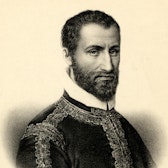
Palestrina: Missa Tu es Petrus & Missa Te Deum laudamus
11/24/2023, 14 Tracks, 1:17:48
Featuring
Martin Baker
Nicholas Keay
William Gaunt
Westminster Cathedral Choir
Tomás Luis de Victoria
Giovanni Pierluigi da Palestrina
Did you know?
1/7
Composer Biography
Giovanni Pierluigi da Palestrina, a major composer of polyphonic choral music, was born in Palestrina, a town near Rome, and received his first musical training in Rome.
Compositional Technique
Victoria's setting of the 'Te Deum' is unusual for an alternatim composition because virtually all the music for the choral verses is in a non-fugal homophonic style.
Composer Biography
Palestrina was dismissed from the Pope's official chapel, the Cappella Sistina, because he was married, as the new Pope Paul IV insisted on celibacy for its members.
Composer Biography
Tomás Luis de Victoria, considered the greatest composer of the Spanish 16th-century 'golden age' of polyphonic music, spent twenty years in Rome before returning to Spain.
Compositional Technique
Palestrina's Missa Te Deum laudamus is a paraphrase Mass, meaning it is based on an existing chant, the 'Te Deum', from which it draws musical material and melodic motifs.
Compositional Technique
Palestrina's Missa Tu es Petrus is a parody Mass, closely based on his own motet for the Feast of St Peter and St Paul, from which much of its musical material is drawn.
Historical Context
The 'Te Deum' is an ancient hymn of thanksgiving, with origins possibly before the mid-fourth century, used historically for processions, liturgical dramas, and celebrating victories.
You might also enjoy...
Palestrina / Lassus: Masses
Palestrina Revealed - Byrd, White, Mundy
Palestrina: Motets & Mass
The Tallis Scholars Sing Palestrina
The Golden Renaissance: Palestrina
Palestrina: Missa O rex gloriae & Missa Viri Galilaei
Palestrina: Missa Papae Marcelli / Allegri: Miserere
Palestrina, Vol. 9
Musica della Capella Sistina: Allegri, Josquin, Palestrina & Morales
Palestrina - Twilight of the Italian Renaissance
Palestrina - Music for Inner Peace
Palestrina: Missa Ecce ego Johannes & Other Sacred Music
Gabrieli: Sacrae symphoniae
Allegri: Miserere - Palestrina: Missa Papae Marcelli