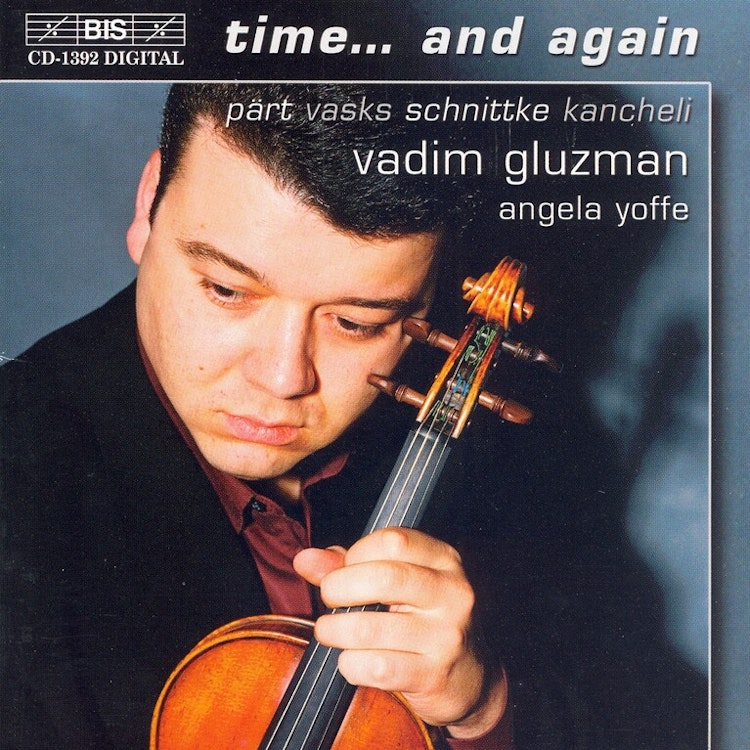
Part / Vasks / Schnittke / Kancheli: Time... and Again
4/1/2005, 15 Tracks, 1:19:46
Featuring
Vadim Gluzman
Angela Yoffe
Alfred Schnittke
Arvo Pärt
Pēteris Vasks
Giya Kancheli
Did you know?
1/7
Composer's Artistic Vision
For Arvo Pärt, the tintinnabulation technique is a religious representation, where the melodic voice symbolizes 'daily egoistic life of sin and suffering' and the triadic voices represent the 'objective realm of forgiveness'.
Composer Biography
Alfred Schnittke was a prolific film composer during the 1960s and 1970s, writing some sixty film scores over his career, which significantly influenced his instrumental composition style.
Compositional Technique
Arvo Pärt's compositional technique, called tintinnabuli, involves one voice consisting of an arpeggiation of the key triad, creating a static, bell-like structure, while a mostly stepwise melody sounds above it.
Performer Biography
Vadim Gluzman, the violinist on this recording, plays the 1690 'ex-Leopold Auer' Stradivari, on loan to him through the Stradivari Society of Chicago.
Compositional Technique
Alfred Schnittke, another composer featured, made important contributions to the postmodern practice of featuring direct quotations or allusions to historical music, particularly baroque music.
Composer's Artistic Vision
Giya Kancheli, one of the composers on this album, feels as close to composers before Bach as to those of the twentieth century.
Historical Context
The musical idiom known as 'Holy Minimalism', typified by composers like Arvo Pärt and Giya Kancheli on this album, draws inspiration from Eastern European churches, folk music, and historical sources like Medieval and Renaissance music.