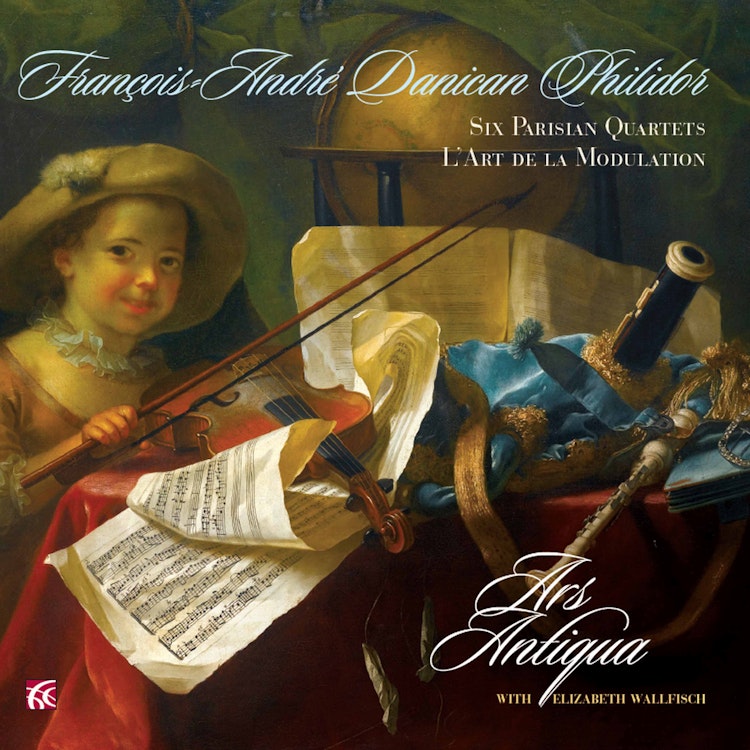
The 'Parisian' quartet, a genre featured on this album, was an innovative form that allowed for a more varied musical language and was recognized as a musical equivalent to the art of conversation.
Composer's Artistic Vision
Philidor's title, L'art de la modulation, refers to the exploration of musical color, similar to how a painter modulates tones on a canvas, rather than strict musical theory.
Interpretation
Philidor, the composer, pragmatically left the exact instrumentation of his quartets open to individual taste, allowing for various combinations of instruments like violins, oboe, or flute.
Composition History
Philidor's Six Parisian Quartets, L'art de la modulation, and a chamber cantata, L'Eté, are his only known chamber pieces, both published in 1755.
Composer Biography
François-André Danican Philidor, the composer of these quartets, was more famous in his time as Europe's first professional chess player than as a musician.
Compositional Technique
Philidor's quartets feature playful chromaticism and dramatic gestures borrowed from opera, capturing the glitter of Rococo stylishness in new ways.
Composer Biography
Philidor, the composer, could simultaneously play three chess games while blindfolded, and his chess treatise remained an important reference for over two centuries.
You might also enjoy...
Chamber Music (Baroque) - Ragazzi, A. / Avitrano, G.A. / Barbella, F. / Marchitelli, P. / Fiorenza, N. (Accademia Per Musica)
The Trio Sonata in 17th-Century Italy
Couperin, F.: Chamber Music
Variety - The Art of Variation. Works for Violin by Biber, Fux & Schmelzer
Telemann: Tafelmusik (Selection)
Musica Napoletana: I Virtuosi del violino, Vol. 3
Trio Sonata in 17th Century England
Marais : Pièces à une et deux violes (Pièces de viole du Premier Livre, Deuxième partie)