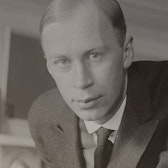
Prokofiev, S.: Piano Music, Vol. 5 - Piano Sonata No. 9 / 4 Etudes / Sarcasms / Piano Sonatina No. 1 / 2 Pieces for Children
1/1/2000, 22 Tracks, 1:19:54
Featuring
Oleg Marshev
Sergei Prokofiev
Did you know?
1/7
Composition History
The 'Sarcasms Op. 17' and 'Toccata Op. 11' confirmed Prokofiev's status as an 'angry young man' of Russian music, with their metallic sound world and outrageous dissonance.
Composer's Artistic Vision
Prokofiev achieved a musical idiom concordant with his principles early in his career, and much of his successive production was concerned less with the evolution of this idiom than with its exploitation to the full.
Composer Biography
Prokofiev's '2 Pieces for Children' are among his earliest works, written when he was about 14 years old, and were recently discovered in the Moscow Central State Archives of Literature and Art.
Composer's Artistic Vision
Prokofiev's piano music, from his 'War' sonatas to the 'Vision Fugitives', is characterized by his ability to create a well-defined mood at the start of a composition, establishing an instant rapport with the listener.
Historical Context
The 1930s were a difficult period for Prokofiev, as he faced increasing pressure to appease Soviet officialdom and witnessed the condemnation of composers like Shostakovich and Khatchaturian for alleged 'formalist' tendencies.
Composer Biography
Prokofiev's '4 Etudes Op. 2' were written during his student period at the St. Petersburg Conservatoire and demonstrate his brilliant keyboard technique and precocious musical mind.
Compositional Technique
Prokofiev's works often appear to develop less through standard tonal procedures and more through the psychological exploitation of 'abstract narrative', guiding the listener through a plot without characters or storyline.
You might also enjoy...
DongKyu Kim: Piano Recital
Prokofiev: Piano Sonatas 8, 9
Sviatoslav Richter 100, Vol. 11 (Live)
Prokofiev: Piano Music, Vol. 2
Prokofiev, S.: Piano Sonatas Nos. 2, 7 and 8
Prokofiev: The War Sonatas; Piano Sonatas Nos. 6, 7 & 8
Prokofiev: War Sonatas
Prokofiev: The War Sonatas
S. Prokofiev - Piano Sonata No.7 Opus 83 & No.2 Opus 14 & No.8 Opus 84
Prokofiev: Piano Sonatas Nos. 6, 7 & 8
Prokofiev: Piano Sonatas, Vol. 3
Prokofiev: The Complete Piano Sonatas, 4 Pieces & 4 Études