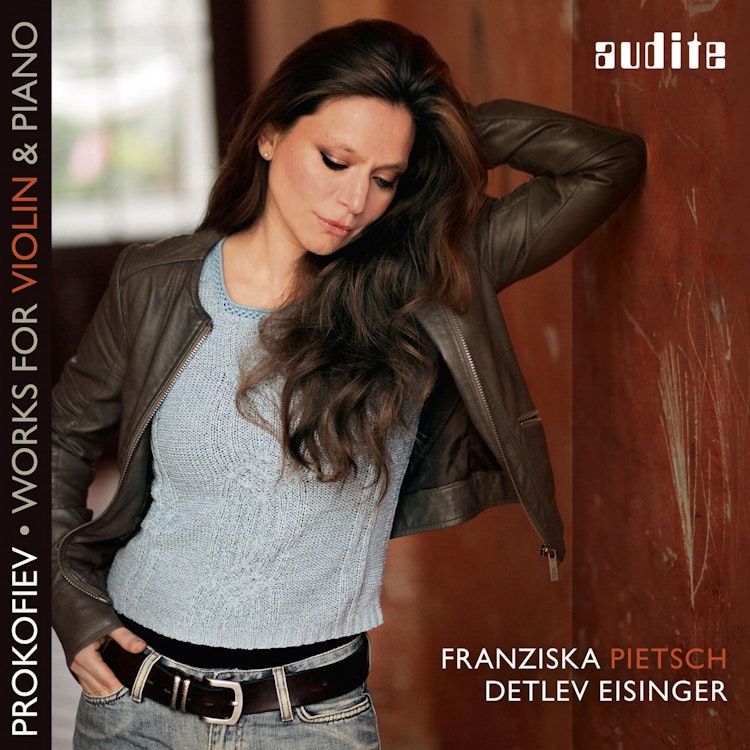
The genesis of Prokofiev's F minor Sonata, Op. 80, spanned eight years, coinciding with a period of political persecution and show trials in the USSR, during which many of his friends and colleagues disappeared.
Composition History
The Cinq mélodies, Op. 35b, were originally written by Prokofiev as 'Songs without Words' for accompanied voice, singing only vowel sounds, before being arranged for violin and piano in 1925.
Instruments
Franziska Pietsch, the violinist on this recording, plays a violin made by Carlo Antonio Testore in Milan in 1751.
Performer Biography
Violinist Franziska Pietsch's early musical training in East Berlin was state-funded and promoted, but she faced reprisals and was forced to leave the country after her father escaped to the West in 1984.
Composition History
Prokofiev's Violin Sonata No. 2 in D major, Op. 94b, was originally composed for flute and piano in 1942, then transcribed for violin and piano in 1944 with the help of violinist David Oistrakh.
Composer Biography
Sergei Prokofiev, the composer, returned to the Soviet Union in 1936 after 18 years abroad, driven by nostalgia and promises from Stalin's regime.
Compositional Technique
Prokofiev likened a 'cold' passage in the first movement of his F minor Sonata, Op. 80, to wind 'sweeping across a cemetery,' highlighting its dark and tragic character.