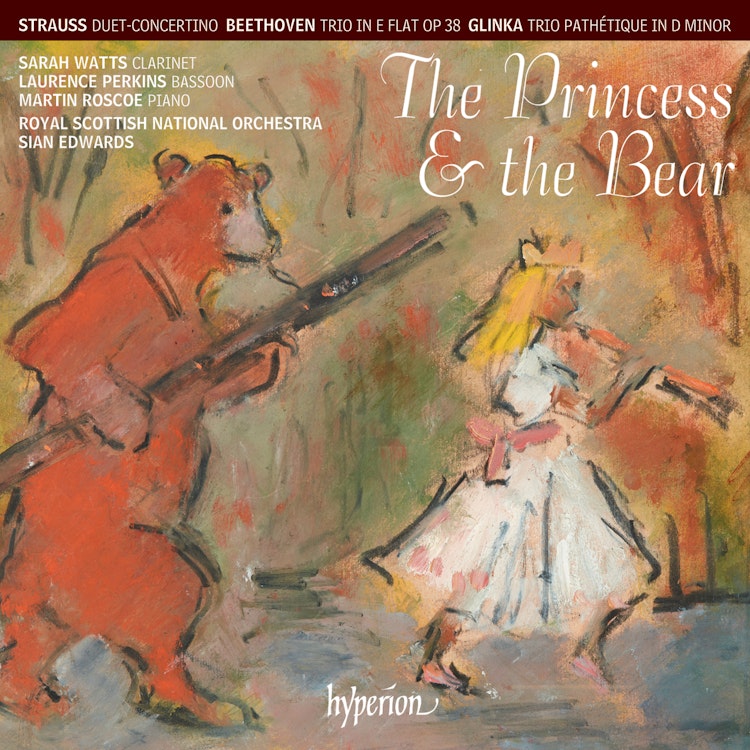
R. Strauss: Duet-Concertino – Beethoven: Trio – Glinka: Trio pathétique
5/10/2024, 13 Tracks, 1:16:16
Featuring
Sarah Watts
Laurence Perkins
Sian Edwards
Martin Roscoe
Royal Scottish National Orchestra
Richard Strauss
Ludwig van Beethoven
Mikhail Glinka
Did you know?
1/7
Recording & Production
This recording was supported by research funding from the Royal Northern College of Music and was recorded in Henry Wood Hall, Glasgow, across two dates in 2014 and 2015.
Compositional Technique
In Richard Strauss's Duet-Concertino, the composer creates a clumsy dance for the bear by writing the two solo parts (clarinet and bassoon) in different time signatures, resulting in incompatible rhythms.
Composition History
Mikhail Glinka's Trio pathétique in D minor was heavily influenced by his studies at the Milan Conservatory and coincided with the unpleasant breakup of a love affair, leading him to write on the manuscript: 'I only know about love from the pain that it causes.'
Composer Biography
Mikhail Glinka, born in 1804, is considered the main figure in establishing musical nationalism in 19th-century Russia, despite his short life and patchy early musical education.
Historical Context
Richard Strauss's Duet-Concertino, completed in 1947, can be seen as an allegory for unity and mutual understanding between societies, reflecting the composer's devastation by the destruction of Dresden in WWII.
Composer's Artistic Vision
Richard Strauss's Duet-Concertino is based on the classic fairy tale Beauty and the Beast, which Strauss told to Hugo Burghauser, the principal bassoonist of the Vienna Philharmonic and dedicatee of the piece.
Composition History
Beethoven's Trio in E flat major Op 38 is an arrangement of his popular Septet, Op 20, which he created himself in 1803 for smaller forces, likely motivated by the prospect of earning extra money.
You might also enjoy...
Music of Varèse, Penderecki & Ligeti
Poulenc: Complete Music for Wind Instruments and Piano
Gerhard: Piano Trio, Cello Sonata, Concierto para Ocho & Libra