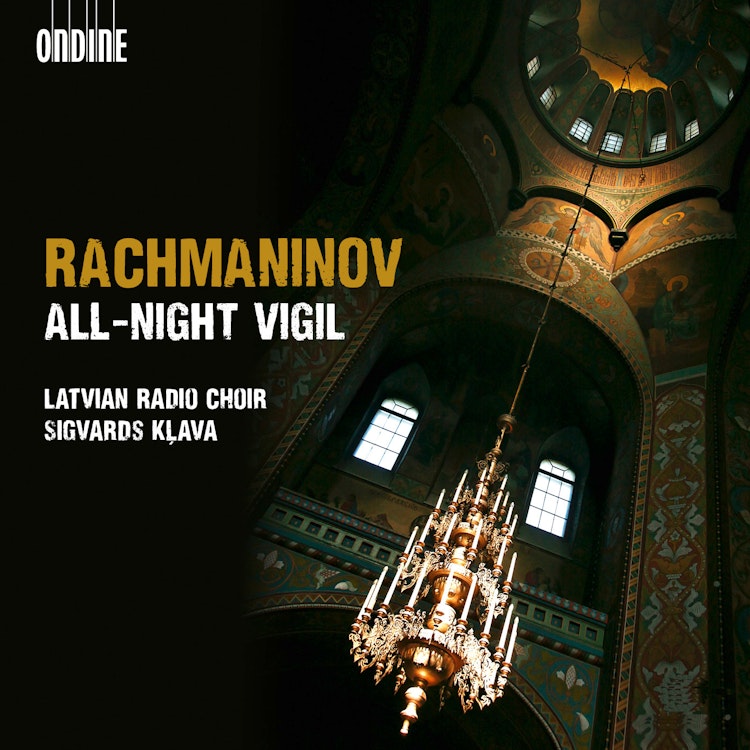
The All-Night Vigil was not published in Russia from 1922 until the collapse of Communism, due to Rachmaninov leaving Russia after the October Revolution in 1917.
Compositional Technique
The All-Night Vigil often divides the chorus into eight sonorous parts, but also features a solo tenor with soft choral support in the Nunc dimittis (No 5).
Compositional Technique
For nine of the 15 sections in the All-Night Vigil, Rachmaninov used traditional Orthodox chants, while the remaining six are his own interpretations of Russian Church music motifs.
Compositional Technique
The choral bass line in the Nunc dimittis (No 5) descends to a bottom B flat, a range so low that Rachmaninov was asked, 'Where on earth are we going to find such basses?'.
Cultural Impact
Rachmaninov later incorporated the ninth number, 'Blessed Art Thou, O Lord', from the All-Night Vigil into his Symphonic Dances, his last orchestral work of 1940.
Notable Performances
The All-Night Vigil was first performed on March 10, 1915, by the Synodal Choir conducted by Nikolay Danilin.
Composition History
Rachmaninov sought advice from Alexander Kastalsky, director of the Synodal Academy in Moscow, and Nikolay Danilin, who conducted the Synodal Choir, for liturgical matters concerning the All-Night Vigil.
You might also enjoy...
Sergei Rachmaninov: Vespers
Rachmaninov: All-Night Vigil, Op. 37
Pyotr Ilyich Tchaikovsky: Works for Choruses
Henryk Górecki: Church Songs, Op. 84
Lewkovitch, B.: 3 Madrigals / Improperia Per Voci / Tenebrae-Responsoria / Il Cantico Delle Creature
Grechaninov: 7 Days of Passion (The)
Rachmaninoff: Vespers, Op. 37 (Live)
Tchaikovsky: Liturgy of St. John Chrysostom, Op. 41 TH 75