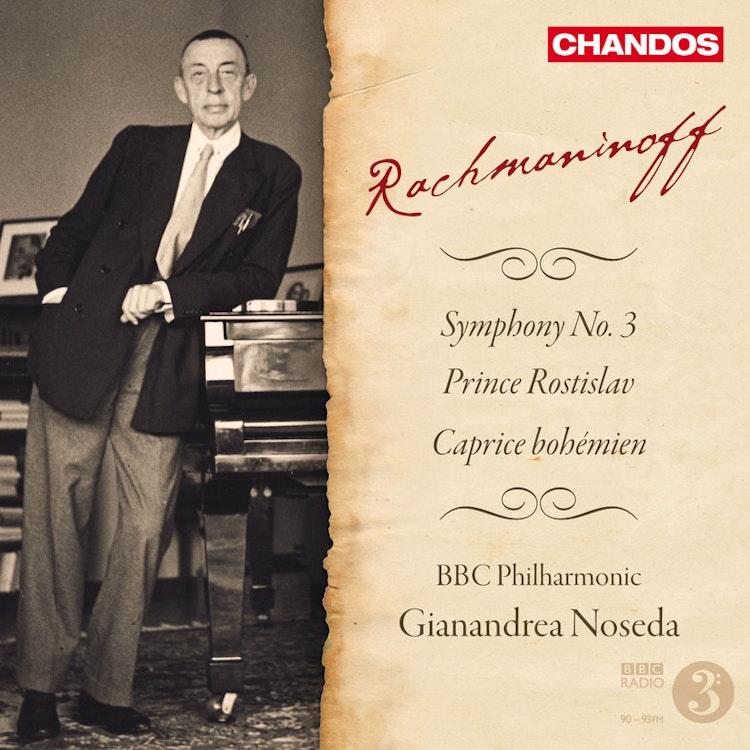
Rachmaninov: Symphony No. 3 - Prince Rostislav - Caprice bohémien
7/5/2011, 5 Tracks, 1:13:48
Featuring
Gianandrea Noseda
BBC Philharmonic
Sergei Rachmaninoff
Did you know?
1/7
Performer Biography
Gianandrea Noseda, the Chief Conductor of the BBC Philharmonic, is also the Music Director at the Teatro Regio in Turin and has been an exclusive artist of Chandos since 2002.
Composition History
Rachmaninoff built a house called Senar on Lake Lucerne, named after an amalgam of his and his wife Natalia's first names, where he composed parts of his Third Symphony.
Composer's Artistic Vision
Rachmaninoff's three symphonies all begin with narrow, intervalled themes that reflect his lifelong interest in the stepwise chants of the Russian Orthodox Church.
Compositional Technique
The Third Symphony introduces a new approach to the Tchaikovskyan 'fate-motif' with a ghostly, three-note reminiscence given to clarinet, muted horn, and muted solo cello.
Composer Biography
Serge Rachmaninoff composed only five works with official opus numbers in the twenty years after leaving Russia in 1917, compared to thirty-nine in the preceding twenty-six years.
Composition History
Rachmaninoff's symphonic poem Prince Rostislav, completed when he was eighteen, was dedicated to Anton Arensky, a distinguished professor at the Moscow Conservatoire, but was not performed until after Rachmaninoff's death.
Compositional Technique
Rachmaninoff's most consistent macabre signature-theme, the Dies Irae (Latin chant for the dead), appears in the slow movement and finale of the Third Symphony.