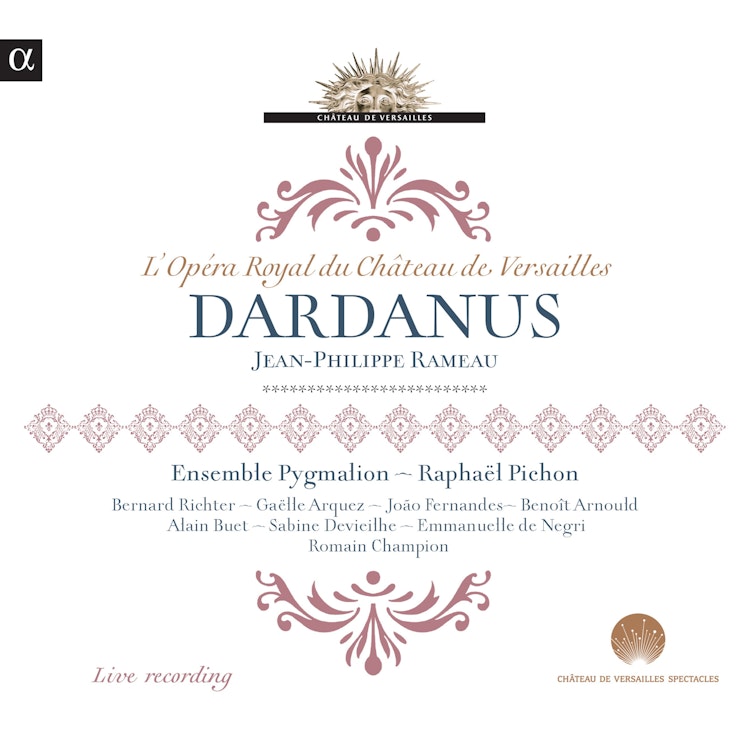
Rameau: Dardanus (Live Recording at l'Opéra Royal du Château de Versailles)
9/24/2013, 68 Tracks, 2:25:14
Featuring
Raphaël Pichon
Sabine Devieilhe
Emmanuelle de Negri
Gaëlle Arquez
Benoît Arnould
Alain Buet
Romain Champion
João Fernandes
Bernard Richter
Pygmalion
Jean-Philippe Rameau
Did you know?
1/7
Composition History
Dardanus underwent significant revisions, with two successive versions differing not only musically but also in their plot and libretto, due to the initial poor reception of the libretto.
Notable Performances
The second version of Dardanus, revived in 1760, featured the renowned singer Sophie Arnould and an admirable stage set for Act IV, inspired by Piranesi's 'Carceri d'Invenzione' and designed by René-Michel Slodtz.
Composer Biography
Jean-Philippe Rameau, the composer of Dardanus, was born in 1683, the same year as other Baroque masters like Bach, Handel, and Scarlatti.
Critical Reception
The first version of Dardanus, despite its beautiful music and outstanding cast, had limited success due to an inept libretto, leading Rameau and his librettist, La Bruère, to make extensive changes.
Compositional Technique
In the aria 'Lieux funestes' from Act IV of Dardanus, Rameau uses a sombre bassoon obbligato and rich harmony, with specific musical devices like a diminished seventh chord for 'lieux funestes' and a fourth-fifth dissonance for 'douleur', to convey the text's emotional content.
Composer Biography
Rameau was considered 'out of phase' with his contemporaries, as he composed his first opera, Hippolyte et Aricie, at the late age of fifty, having previously focused on keyboard pieces and a scholarly treatise on harmony.
Recording & Production
This recording was made at the Royal Opera House in Versailles, a venue that reopened to the public in 2009 after extensive restoration work.