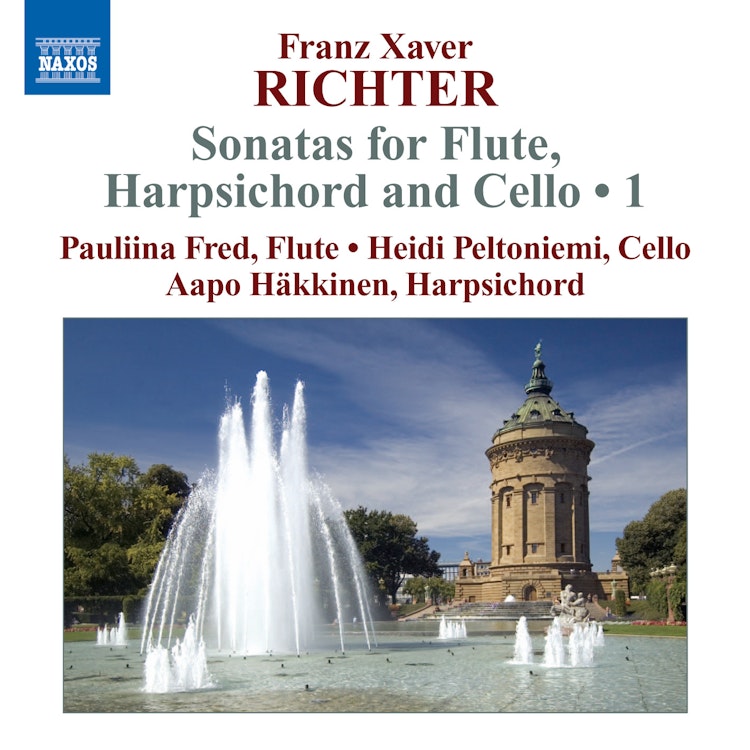
Richter: Sonatas for Flute, Harpsichord and Cello, Vol. 1
7/4/2011, 9 Tracks, 1:00:28
Featuring
Aapo Häkkinen
Heidi Peltoniemi
Pauliina Fred
Franz Xaver Richter
Did you know?
1/7
Compositional Technique
The harpsichord's role in Richter's Sonate da camera is thematically and contrapuntally rich, treating its upper voice like a second treble solo instrument, similar to J. S. Bach's sonatas with obbligato harpsichord.
Instruments
Pauliina Fred, the flutist, plays a one-keyed transverse flute made in 2006 by Claire Soubeyran, which is modeled after an instrument by Godefroy Adrien Rottenburgh from around 1760.
Composer Biography
Franz Xaver Richter, the composer, may have been taught in Vienna by Johann Joseph Fux, an Imperial Kapellmeister and author of the influential counterpoint treatise Gradus ad Parnassum.
Critical Reception
Dr. Charles Burney, a contemporary music historian, considered Richter one of the foremost Mannheim composers, admiring his instrumental counterpoint and inventive thematic construction.
Compositional Technique
Richter's musical style combines old and new elements, using piquant dissonances and expressive ornamentation characteristic of C.P.E. Bach's empfindsamer Stil, alongside Italianate grace and a fundamental structural model found in his symphonies.
Composer's Artistic Vision
Richter, while connected to the famous Mannheim court orchestra, resisted many new stylistic developments, preferring to root his works in an older tradition, resulting in richer harmonies and more imaginative part-writing.
Performer Biography
Aapo Häkkinen, the harpsichordist, won second prize at the Bruges Harpsichord Competition in 1998 and was awarded the NDR special prize for his interpretations of Italian music.
You might also enjoy...
Raykhelson: Violin Concerto - Viola Concerto
Janacek, L.: Operatic Orchestral Suites, Vol. 3 - the Cunning Little Vixen / From the House of the Dead
Weismann: String Quartets (Arr. for String Orchestra)
Zuccari: Mass in C Minor & Magnificat in F Major
Richter, F.X.: Grandes Symphonies (1744), Nos. 7-12 (Set 2)
Herold: Overtures and Symphonies
Rameau: Six Concerts en sextuor
Abel, C.F.: Symphonies, Op. 17, Nos. 1-6
Graener: Orchestral Works, Vol. 4
Sacrum Mysterium (A Celtic Christmas Vespers)
Zeidler: Missa in D Major
Balakauskas: Concerto Brio for Violin and Chamber Orchestra / Ludus Modorum / Piano Concertino