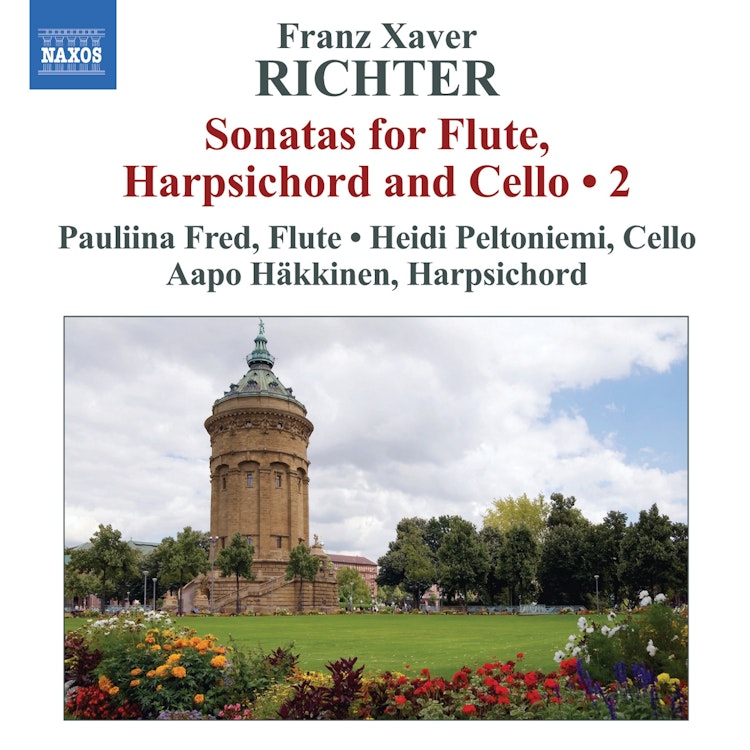
Richter: Sonatas for Flute, Harpsichord and Cello, Vol. 2
9/1/2011, 11 Tracks, 1:01:27
Featuring
Pauliina Fred
Heidi Peltoniemi
Aapo Häkkinen
Franz Xaver Richter
Did you know?
1/6
Composer's Artistic Vision
Richter's musical style blends old and new, combining elements like the empfindsamer Stil of C.P.E. Bach with Italianate grace and employing structural models found in his symphonies.
Composition History
The sonatas on this album were published in two sets, with the first appearing in 1759 and the second in 1763, though their exact composition dates are unknown.
Composer Biography
Franz Xaver Richter, though associated with the Mannheim court orchestra, was primarily a singer and was described as a virtuoso di camera.
Critical Reception
Dr. Charles Burney, a contemporary music historian, considered Richter one of the foremost Mannheim composers, despite Richter consciously avoiding the fashionable style of the time.
Compositional Technique
Richter's harpsichord writing is thematically and contrapuntally rich, treating the upper voice like a second treble solo instrument, similar to J.S. Bach's obbligato sonatas.
Composer's Artistic Vision
Richter resisted many new formal and stylistic developments pioneered by Johann Stamitz, the Mannheim orchestra's music director, preferring an older tradition with richer harmonies.
You might also enjoy...
Perle del Piemonte: Violin Music in 18th-Century Italy
Heinsius: Symphonies Nos. 1-6 - Lentz: Concertos Nos. 1 & 2 for Harpsichord and Strings
Fidicinium Sacro-Profanum
Stamitz: Symphonies, Op. 3 Nos. 1 & 3-6
Bach: Sonatas for Violin and Continuo; and works by Schmelzer, Schenk, Böhm and Erlebach
Treasures: Chamber Music from the Collection of Earl Rudolf Franz Erwein von Schonborn zu Wiesentheid
Bach: Trio Sonatas
Aufschnaiter: Serenades
Chamber Music (18Th Century) - Bach, C.P.E. / Schaffrath, C. / Zarth, G. / Graun, J.G.