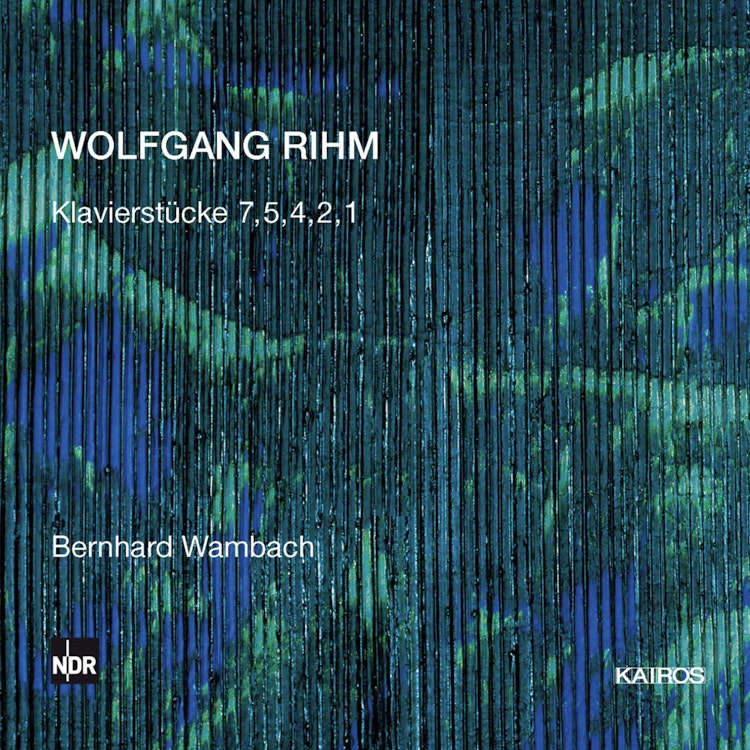
Bernhard Wambach has collaborated with many notable composers, including Karlheinz Stockhausen, Pierre Boulez, Luigi Nono, and Iannis Xenakis.
Performer Biography
Bernhard Wambach, the pianist on this album, is a laureate of the International Arnold Schönberg Competition (1979) and the Kranichsteiner Music Award (1982).
Composer's Artistic Vision
Wolfgang Rihm's use of sequential numbers for his Klavierstücke may be an homage to his teacher, Karlheinz Stockhausen, a renowned composer of electronic and serial music.
Composer's Artistic Vision
Wolfgang Rihm, the composer, stated that his piano music is not a separate block but rather participates in the broader issues of his entire creative output.
Composer Biography
Wolfgang Rihm had his international breakthrough in 1974 at the Donaueschinger Musiktage and has been a professor of composition at the Musikhochschule Karlsruhe since 1985.
Composer's Artistic Vision
Wolfgang Rihm views each of his works as a fragment from a continuous "musical mine" where creative prospecting is always ongoing.
Compositional Technique
Wolfgang Rihm's Klavierstück Nr. 4 derives its basic proportions (5:7:2:9) from his large-scale orchestral work Dis-Kontur, compressing them into a rondo-like form.
You might also enjoy...
Animal Universe
Jóhann Jóhannsson: Piano Works – From Englabörn
Reading O'Halloran - Music by Dustin O'Halloran
Benjamin: Complete Piano Works
Rihm: Piano Pieces
Silvestrov: Piano Sonata No. 1 / 3 Postludes / 2 Dialogues With an Epilogue / 3 Waltzes