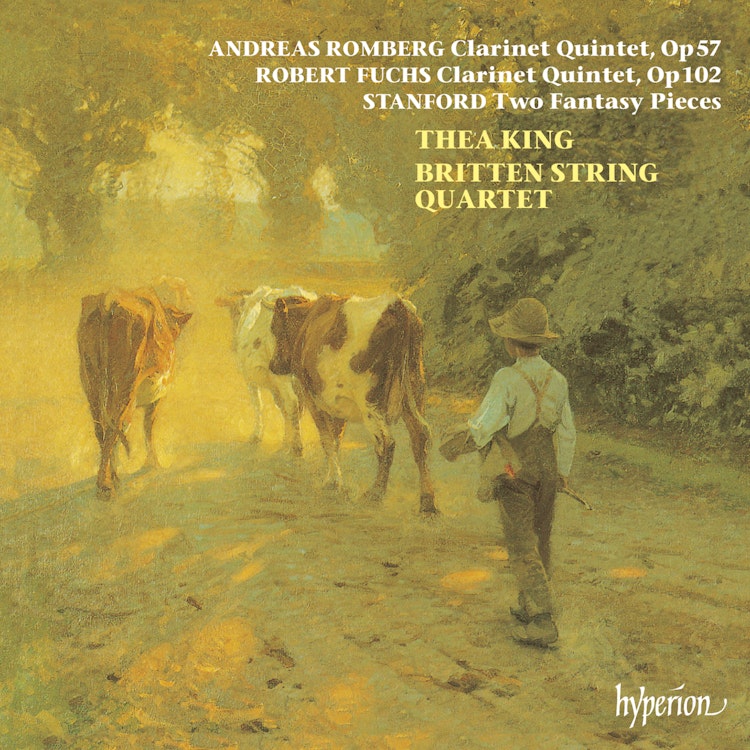
Before the 20th century, composers like Romberg, Fuchs, and Stanford favored the clarinet for its lyrical, euphonious quality, rich warmth, and broad range of tone colors.
Critical Reception
The Clarinet Quintet by Robert Fuchs was enthusiastically received at its 1917 premiere, with the Neue Freie Presse Wien describing it as 'the scents and colours of soft spring blossoms set to music'.
Composer Biography
Robert Fuchs, a composer featured on this album, was better known for the composers he taught, including Mahler, Sibelius, and Wolf, than for his own compositions.
Composer Biography
Andreas Romberg, a violinist, and his cousin Bernhard Heinrich Romberg, a cellist, toured together as children and both joined the electoral orchestra in Bonn, where the young Beethoven played viola.
Instruments
The clarinet, of all woodwind instruments, most closely approximated the human voice until the saxophone was invented.
Composition History
The 'fantasy' form, used by Charles Villiers Stanford in his Two Fantasy Pieces, was revived by W. W. Cobbett, an English amateur violinist and patron of music, as a modern analogue to Elizabethan viol fancies.
Compositional Technique
Andreas Romberg's Clarinet Quintet features an unusual combination of one violin and two violas, likely to emphasize the importance of his own instrument, the violin.
You might also enjoy...
Weber, Krommer & Baermann: Clarinet Quintets
Beach, A.: Theme and Variations / Ginastera, A.: Impresiones De La Puna / Foote, A.: Nocturne and Scherzo (Music for A Sunday Morning)
Barber - Nielsen - Taffanel
Reicha: Variations - Bassoon Quintet in B flat major
Reger - Hindemith: Clarinet Quintets
Barber: Summer Music / Carter: Woodwind Quintet
Anna Clyne: Strange Loops, Ruth Gipps: Rhapsody, Weber: Clarinet Quintet