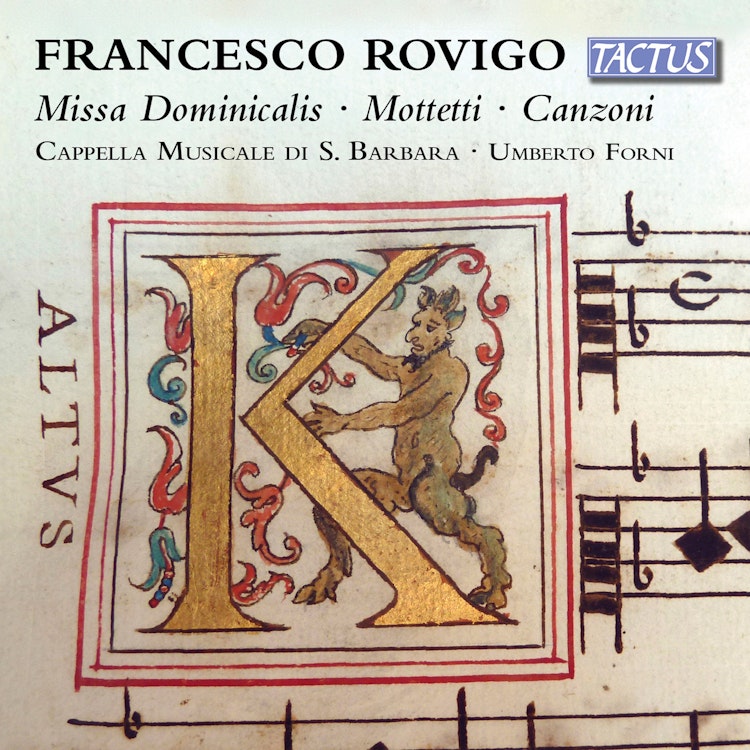
The Duke of Mantua, Guglielmo Gonzaga, requested an "alternatim" structure for the S. Barbara repertoire, alternating polyphonic music with plainsong, which led to the creation of "Mantuan Masses."
Composer Biography
Rovigo was praised for his organ playing, with a ducal secretary in 1582 describing him as "uncommonly good at playing the organ."
Composer Biography
Francesco Rovigo, the composer, was highly esteemed by Duke Guglielmo Gonzaga of Mantua, who sent him to study with the renowned Claudio Merulo in Venice.
Compositional Technique
The practice of replacing secular texts with sacred ones, known as "contrafactum," was common in the 16th century, as seen in a motet on this album which reuses music from Rovigo's madrigal "Ardo sì, ma non t'amo."
Historical Context
Rovigo was buried in the Basilica of S. Barbara at the altar of St. John, near Giaches de Wert, the Flemish Kapellmeister who died the previous year, signifying their importance to the Gonzaga family.
Composer Biography
Rovigo held prestigious and well-paid positions, even being cited by Claudio Monteverdi in 1608 as an example of a highly compensated musician, in contrast to Monteverdi's own low pay.
Historical Context
The "Mantuan Masses" were based on melodies from the Kyriale, a codex containing fixed chants, and were composed by prestigious musicians of the period, including Giovanni Pierluigi da Palestrina.
You might also enjoy...
Charpentier, Couperin & Moulinié: Le Concert des Violes
Æternum: Music of the Elizabethan Avant Garde from Add. MS 31390
Viola Da Gamba Recital: Dornenburg, John - Hume, T. / Sainte-Colombe, J. / Simpson, C. / Kuhnel, A. / Abel, C.F.
La Hacha
Lagrime
Du Mont: Motets for the Chapel of Louis Xiv at the Louvre
Wiener Stimmung: Works for the Viennese Bass from the Late 18th Century
Albinoni: Sinfonie a cinque, Op. 2 (Alpha Collection)
Sonderlich auff Violen: Musiques des XVIIe et XVIIIe siècles pour les violes de gambe