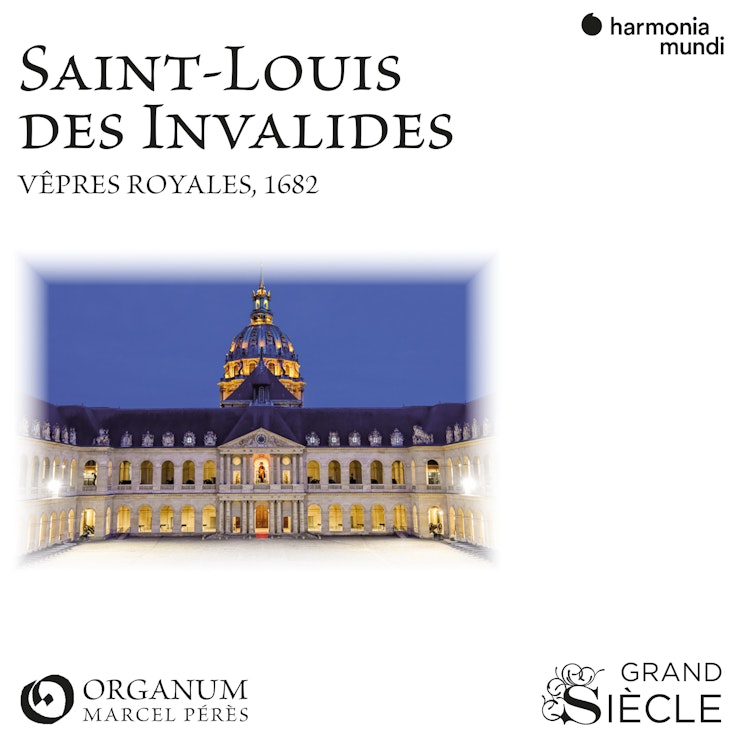
Saint-Louis des Invalides. Vêpres royales, 1682. Ad vesperas Sancti Ludovici Regis Franciae
7/18/2025, 24 Tracks, 1:19:12
Featuring
Marcel Pérès
François-Philippe Barbolozi
Jean-Christophe Candau
Jérôme Casalonga
Gianni de Gennaro
Jean-Étienne Langianni
Antoine Sicot
Frédéric Tavernier-Vellas
Luc Terrieux
Ensemble Organum
Anonymous
Did you know?
1/7
Compositional Technique
Fauxbourdon, a polyphonic practice dating back to the 9th century, involves accompanying a plainchant melody with three or four-note chords, often in parallel motion, with all voices speaking the text simultaneously.
Interpretation
On this recording, the organ alternates with the singing, rather than accompanying it, a practice consistent with Catholic tradition for solemn celebrations.
Instruments
The organ used for this recording, from the Prytanée national militaire de La Flèche, was built in the first half of the 17th century and has retained its original low pitch (A=392 Hz), known as the 'ton d'église'.
Recording & Production
This recording aims to present the multiplicity of musical styles that animated liturgical practices in the 17th and 18th centuries, including plainchant, fauxbourdon, and organ music.
Historical Context
The Gradual and Antiphonal of Saint-Louis des Invalides, a voluminous lectern book from 1682, was created by 'invalides manchots' (invalids who had lost an arm or a hand) at the Hôtel des Invalides, an institution founded by Louis XIV.
Historical Context
Fauxbourdon traditions, which were once widespread, were still in use in France until the mid-20th century but have since disappeared, though they persist in some Mediterranean regions.
Performer Biography
Ensemble Organum, founded in 1982 by Marcel Pérès, has played a decisive role in the revival of medieval music, with their recording of Machaut's Mass being listed by The New York Times among 100 essential records that revolutionized 20th-century music.