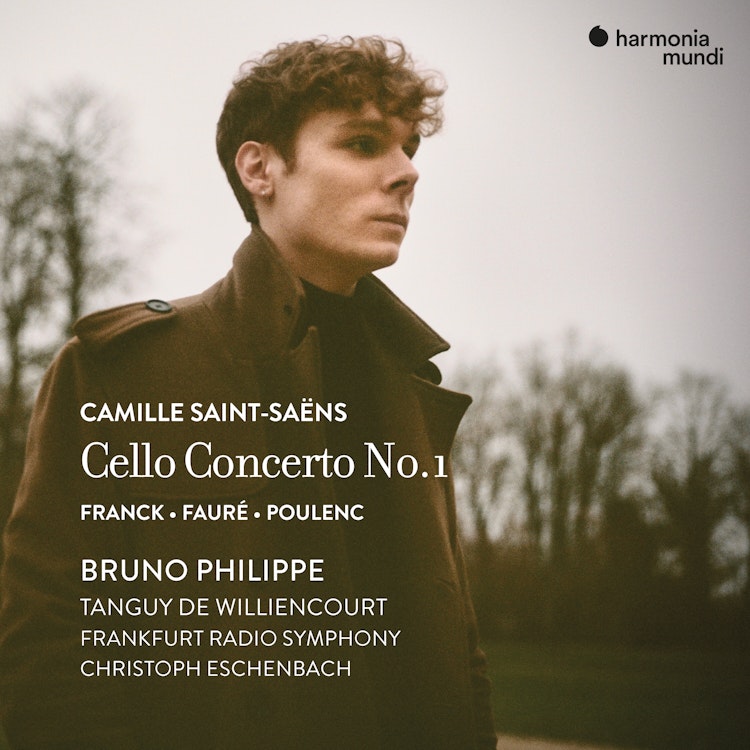
This album brings together three masterpieces of the French and Belgian cello repertoire, interspersed with shorter pieces by Gabriel Fauré.
Compositional Technique
Saint-Saëns's Cello Concerto No. 1, though conceived as a single continuous piece, is divided into three parts that correspond to both sonata form sections and the traditional three movements of a concerto.
Composition History
Fauré's Papillon (Butterfly) was commissioned by publisher Julien Hamelle, who insisted on the title 'Libellules' (Dragonflies), causing a delay in its publication until 1898.
Compositional Technique
César Franck's Violin Sonata employs a 'cyclic' procedure, where three musical ideas run through the movements, creating a complex structure and ensuring the work's unity.
Composer Biography
Francis Poulenc sketched his Cello Sonata in 1940 after being demobilized from the army, but only returned to it in 1948 for a duo with cellist Pierre Fournier.
Composition History
Camille Saint-Saëns's Cello Concerto No. 1 was dedicated to and premiered by the cellist Auguste Tolbecque with the Société des Concerts du Conservatoire in 1873.
Composition History
César Franck's Violin Sonata is played on cello because he died before completing a cello sonata, and cellist Jules Delsart made an arrangement with Franck's blessing.
You might also enjoy...
Faure, G.: Music for Cello and Piano
Fauré Authentique
Fauré : Elégie, Cello Sonate , Piano Trio & Quatuor à cordes