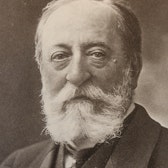
Saint-Saëns's perception as a composer changed throughout his lifetime; he championed progressive figures like Wagner and Liszt in his youth but became more conservative and reactionary to innovators like Debussy and Stravinsky in his later years.
Historical Context
The Société Nationale de Musique, of which Saint-Saëns was a founding member, promoted French composers and their superiority to Germans in the aftermath of the Franco-Prussian war.
Recording & Production
The Malmö Symphony Orchestra and conductor Marc Soustrot began recording the complete works of Camille Saint-Saëns for Naxos in August 2013.
Performer Biography
Gabriel Schwabe, the cellist on this recording, is a laureate of several international competitions, including the Grand Prix Emanuel Feuermann and the Concours Rostropovich, and won the prestigious Pierre Fournier Award in London in 2009.
Composer Biography
Camille Saint-Saëns, born in Paris in 1835, was an extraordinary musical prodigy who made his concert debut at age ten, offering to play any of Beethoven's 32 piano sonatas as an encore.
Compositional Technique
Saint-Saëns enjoyed cyclic patterns in his compositions, using a similar structure in his First Cello Concerto as he did in his First Piano Concerto of 1858, where opening material returns in later movements.
Critical Reception
Saint-Saëns's Second Cello Concerto was less successful than his First, with one critic famously denouncing it as 'bad music well written' after its 1905 premiere.
You might also enjoy...
Yo-Yo Ma Plays The Music of John Williams (Remastered)
Tchaikovsky: Variations On A Rococo Theme / Pezzo Capriccioso
Elgar & Tchaikovsky: Cello Works
Saint-Saens, C.: Cello Concertos Nos. 1 and 2 / Suite in D Minor / Allegro Appassionato / The Swan
Violincellokonzerte - D'Albert / Bruch / Dohnányi
Ben-Haim, Bloch & Korngold: Works for Cello & Orchestra
Victor Herbert: Cello Concertos
Tchaikovsky: Rococo Variations; Souvenir de Florence; Lensky's Aria From "Eugen Onegin"; Nocturne In D Minor (From Op. 19, No. 4); Andante Cantabile, Op. 11