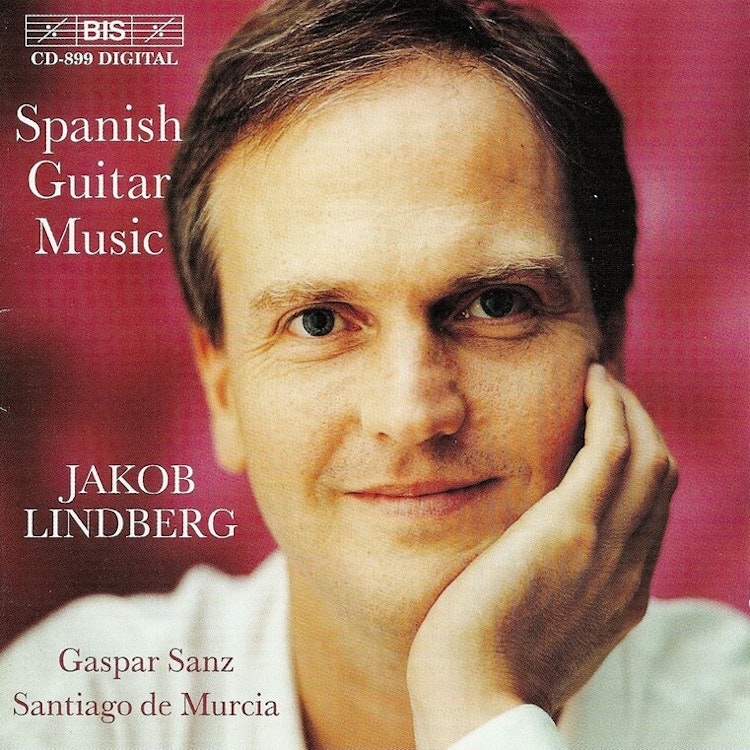
Gaspar Sanz, a composer on this album, believed the guitar's merits or defects lie with the player, not the instrument itself, comparing it to a lady whose rose will not wither no matter how much it is touched by skilled hands.
Compositional Technique
Both composers on this album, Gaspar Sanz and Santiago de Murcia, utilized 'rasgueado' (strumming) and 'punteado' (plucking) techniques in their guitar music, sometimes integrating them for dramatic effect.
Performer Biography
Jakob Lindberg, the performer on this album, developed his initial passion for music through The Beatles and is now a prolific performer and professor of lute at the Royal College of Music in London.
Historical Context
During the 17th century, the five-course baroque guitar was known throughout Europe as the 'Spanish Guitar' because the fifth course was added in Madrid by Maestro Espinel, a Spaniard.
Cultural Impact
The Fandango, a dance featured in Murcia's work, was described as a dance for men and women in pairs who, without touching, would express emotions with glances, gestures, and 'voluptuous steps' to 'inflame' dancers and fill spectators with 'ecstasy'.
Composer Biography
Gaspar Sanz, a composer featured on this album, studied theology at the University of Salamanca before traveling to Italy to study music, where he was taught by notable musicians like Cristoforo Caresana and Lelio Colista.
Historical Context
Some dances in Santiago de Murcia's collection, such as Cumbées and Zarambeques, likely originated in the African community in Mexico and were brought to Europe from the New World, often used in Spanish theatrical productions.
You might also enjoy...
Corbetta, F.: Varii Scherzi Di Sonate / Mantovana / Sinfonia / Folia (A Guitarist From Pavia Across Europe) (La Ghirlanda Mosicale)
John Anthony Lennon - Player's Fair
European Renaissance & Baroque Music for Guitar
The Music of Mikhail Glinka: The Czar's Guitars
Cifras selectas de guitarra: Guitar Muic by Santiago de Murcia
La Mascarade - Music For Solo Baroque Guitar And Theorbo
Here, There And Everywhere: Goran Sollscher plays The Beatles
SPANISH GUITAR MUSIC AROUND 1930
Corbetta: La guitarre royalle
Moreno Torroba: Guitar Concertos, Vol. 2
Rossini & Giuliani: Semiramide, Opera Arrangements for Solo Guitar
J.S. Bach: Cello Suite No. 4 in E-Flat Major, BWV 1010: IV. Sarabande
Jonas Tamulionis - Selected Compositions For Guitars
Krouse, I.: Labyrinth On A Theme of Led Zeppelin / Eagan, M.: Red, White, Black 'N' Blue / York, A.: Quiccan