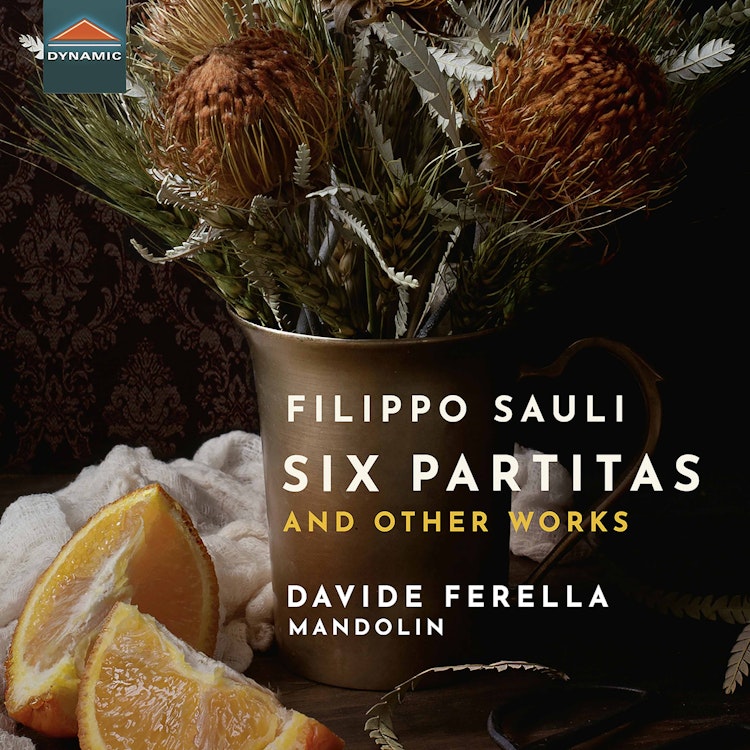
Davide Ferella is a dedicated scholar and researcher, focused on rediscovering and promoting 17th and 18th-century mandolin repertoire, and has published several works on the subject.
Instruments
The mandolin most popular in the 17th and early 18th centuries was not the Neapolitan mandolin, but a different instrument, also called mandolin or mandola, tuned in fourths with four to six courses of gut strings.
Performer Biography
Davide Ferella, the mandolinist on this recording, specializes in performing on original instruments, including 5- and 6-course mandolins, Neapolitan baroque mandolins, and Brescian mandolins.
Compositional Technique
Sauli's music for mandolin features polyphonic sections and uses writing styles borrowed from lute tradition, such as freely arpeggiated chords in the Prelude of Partita IV.
Historical Context
The mandolin, initially having a secondary role, became a prominent instrument by the end of the 17th century, appearing in diverse ensembles like operas, oratorios, and chamber and solo repertoires.
Compositional Technique
Filippo Sauli's Sei Partite are unique in early 18th-century mandolin repertoire for their form and musical character, with the only surviving manuscript copy written in French tablature, a notation common for lute music but rare for mandolin.
Composer Biography
Filippo Sauli, one of the composers featured, worked as a theorbo player at the Hapsburg court of Joseph I from 1707 or 1709 to 1721.
You might also enjoy...
A Mandolin's Guide to Hamburg
Avi Avital: The Verbier Recital
Serenata Napoletana: Music for Mandolin and Piano
Conlon Nancarrow: Studies for Player Piano, Vol. IV
Sauli: Partita No. 3 in C Major: V. Giga
Drumming
J.S. Bach: Violin Sonatas & Partitas
Conlon Nancarrow: Studies for Player Piano, Vol. III