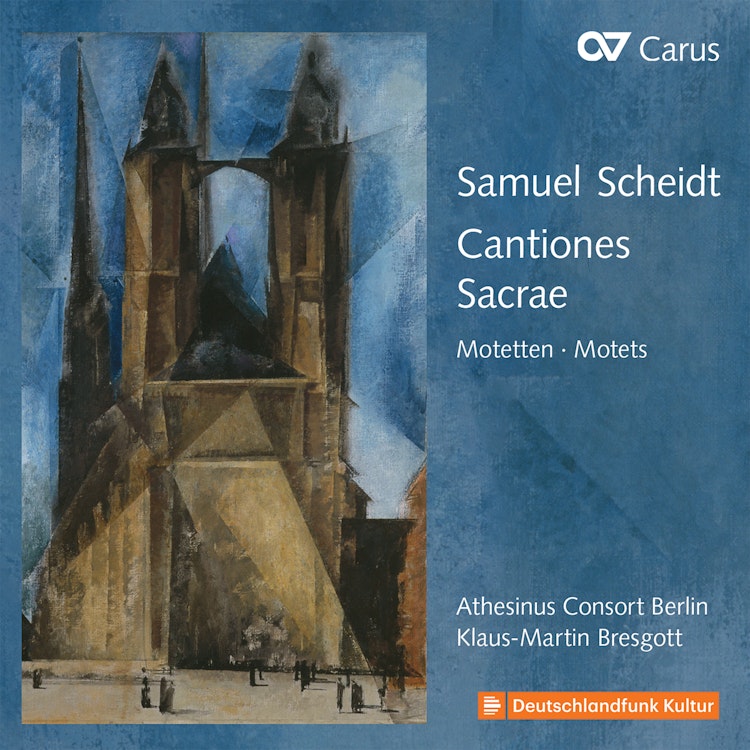
Unlike his contemporaries who often used five to seven voices, Samuel Scheidt chose an opulent eight-part double choir setting for his Cantiones sacrae.
Recording & Production
This album includes a contemporary motet, Die Stimme meines Freundes (2016), by Berlin composer Frank Schwemmer (*1961), commissioned to provide a contrast to Scheidt's sonorities.
Composer Biography
Samuel Scheidt (1587-1654) is considered one of the most important German composers of the 17th century, completing a famous trio of Central German early Baroque composers.
Composition History
Samuel Scheidt's Cantiones sacrae, a collection of 38 motets, was published in 1620, predating similar collections by his contemporaries Johann Hermann Schein and Heinrich Schütz.
Composer Biography
Samuel Scheidt, along with Heinrich Schütz and Johann Hermann Schein, formed a unique trio of early Baroque composers in Central Germany, each representing a different city.
Composer's Artistic Vision
Samuel Scheidt, originally from a keyboard background, focused more on musical architecture and contrapuntal setting techniques in his vocal works, in contrast to the more rhetorical or expressive styles of Schütz and Schein.
Composer Biography
Samuel Scheidt studied with the renowned Jan Pieterszoon Sweelinck (1562-1621) in the Netherlands, as did his two younger brothers, Gottfried and Christian Scheidt.