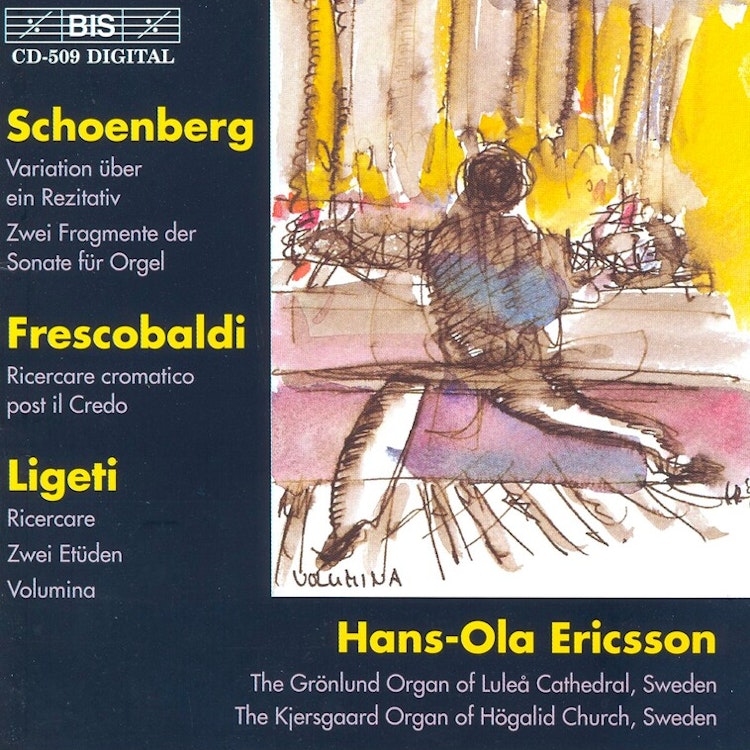
Hans-Ola Ericsson, the organist on this recording, has received multiple Swedish Gramophone Prizes and a 'Grammis' award, and has collaborated with composers like Olivier Messiaen, György Ligeti, John Cage, and Arvo Pärt.
Compositional Technique
Performing György Ligeti's Volumina requires new playing techniques, including playing large clusters with elbows, forearms, and hands, gliding palms over keys, striking keys with fists, and even using feet.
Composition History
Arnold Schoenberg's Variations on a Recitative, Op. 40, was his contribution to the 'Contemporary Organ Series' launched by the New York publishing house H.W. Gray in the late 1930s.
Compositional Technique
György Ligeti's Volumina is a 'radical' work that uses 'tone clusters' (chords built of major and minor seconds) to destroy traditional intervallic relationships, creating 'neutralized and eliminated harmonies'.
Compositional Technique
Arnold Schoenberg's Variations on a Recitative, Op. 40, are cyclical works based on a single theme and are clearly in D minor, showing an influence from Bach's The Art of the Fugue.
Composer's Artistic Vision
György Ligeti was drawn to the organ not only for its rich, unexplored tone colors but also for its perceived weaknesses, such as its clumsiness and stiffness, which he likened to a 'massive artificial leg'.
Composition History
Arnold Schoenberg began composing a sonata for the 'Contemporary Organ Series' but only completed two fragments, a Molto moderato and an Allegretto, which were later published in 1973.
You might also enjoy...
Organ Recital: Ji-Yoen Choi
Rainbow Toccatas
Mendelssohn: The Complete Organ Works Vol. 1
Organ Recital: Noehren, Robert - Widor, C.-M. / Brahms, J. / Bach, J.S. / Alain, J. / Hindemith, P. / Karg-Elert, S. / Messiaen, O.
Felix Mendelssohn: Complete Organ Works, Vol. 5
Orgelmusik aus vier Jahrhunderten (Eberhard Lauer an der Beckerath-Orgel der Domkirche St. Marien zu Hamburg)
J.S. Bach, Krasnovsky & Others: Works for Organ
Orgelmusik zur Weihnachtszeit
Orgelkosmos
Adeste Fideles: Organ Music for Christmas
An Anthology of American Organ Music: Vol. 3 - Music of Charles Ives and Leo Sowerby