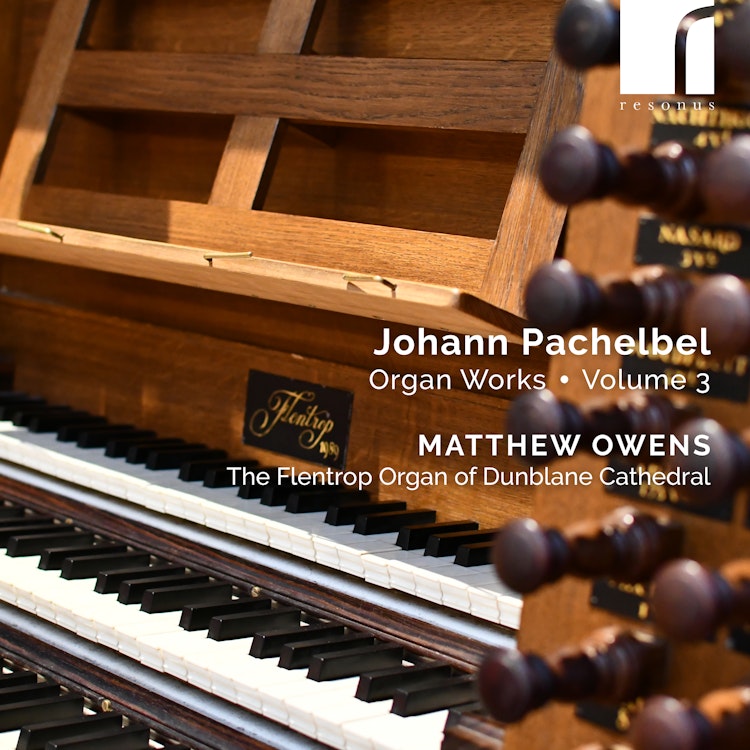
Pachelbel's short preludes, like the Prelude in A minor and Prelude in G Major on this album, likely originated from improvisation, embellishing simple chord progressions.
Composition History
Pachelbel's ninety-four fugues on the Magnificat, including those on this album, date from his final employment period as organist at the Sebaldiskirche in Nuremberg from 1695 to 1706.
Composer's Artistic Vision
Pachelbel's chorale preludes, such as those on this album, aimed to explore the motivic potential of the melody rather than evoking emotions associated with the chorale text.
Composer Biography
Pachelbel's contract as organist at the Predigerkirche in Erfurt from 1678 to 1690 required him to accompany congregational singing of chorales.
Historical Context
In Johann Pachelbel's time, improvisation was a practical technique involving the variation of existing musical materials, not a mysterious art requiring spontaneity.
Compositional Technique
Pachelbel pioneered the pairing of a rhapsodic prelude with a short fugue, a technique exemplified by the Prelude and Fugue in E minor on this album.
Performer Biography
Matthew Owens, the organist on this recording, was previously the director of music at Wells Cathedral, where its choir was named the best in the world with children by Gramophone.
You might also enjoy...
Bach: Organ Works, Vol. 10 & 11 (At the Organ of Saint Walburgis Church in Zutphen)
Bach at Amorbach
Orgelmusik zur Weihnachtszeit
Pachelbel: Organ Works, Volume 2
Dietrich Buxtehude: Complete Organ Works III
Complete Organ Works & Other Keyboard Works 1: Toccata in D minor and other early works vol.1 (Bach)
Buxtehude: Complete Organ Works, Vol. 1
Organ Recital: Scholze, Hansjurgen – Clerambault, L.N. / Pachelbel, J. / Mozart, W.A. / Bach, J,S.
Bach, J.S.: Influences of Cantata, Concerto and Chamber Music (Organ Works)
Organ of the Mother of God of the Scapular Church in Szymbark