Unlike Beethoven, who developed motifs until exhaustion, Schubert's themes are like figures on a stage, changing only in 'colour' or illumination, such as appearing in darkness or bright light.
Compositional Technique
In his first orchestral work, Franz Schubert did not compose with contrasting keys like Beethoven, but was more interested in individual tones, often orbiting a 'favourite tone'.
Interpretation
Roland Moser's completion of Schubert's D major Symphony fragment aims to make the 'fragility shortly before death' audible, avoiding a false sense of perfection.
Compositional Technique
The Scherzo of Schubert's D major Symphony fragment is unique for its through-composed form with two trios, a continuous development process unlike the repetitive structures of Beethoven or Bruckner.
Composition History
Schubert, shortly before his death, consulted the Viennese theorist Simon Sechter and Friedrich Wilhelm Marpurg's 'Treatise on the Fugue' to study counterpoint, which is reflected in his late symphony sketches.
Composition History
The sketch for Schubert's D major Symphony fragment was identified as a late work from 1828 by analyzing the paper it was written on, distinguishing it from earlier D major symphony drafts.
Recording & Production
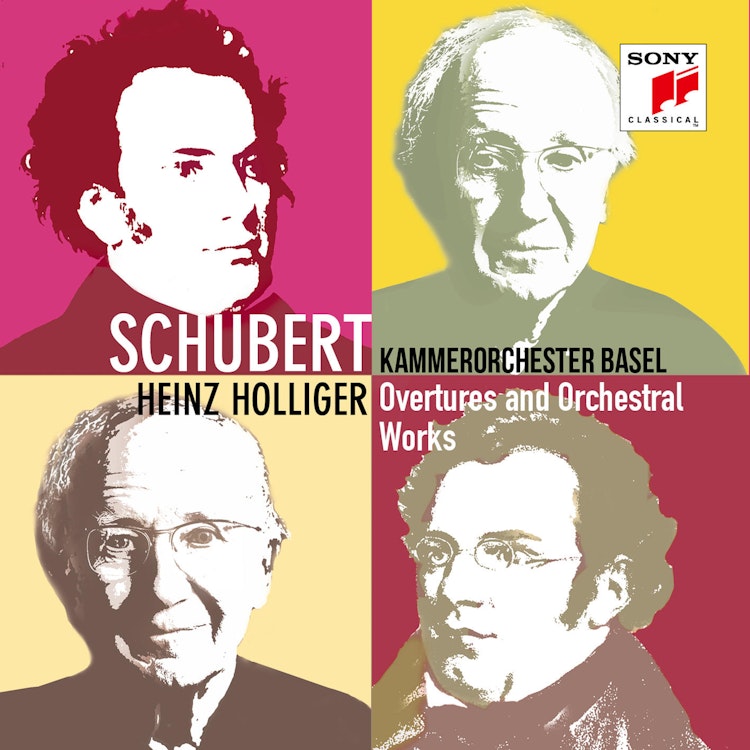
This recording is the final part of a complete cycle of Franz Schubert's symphonies, performed by the Basel Chamber Orchestra and conducted by Heinz Holliger.
You might also enjoy...
Goldmark: Orchestral Works
Enescu: Ouverture op. 32/Symphony No. 3 op. 21
Ives: Symphony No. 2 / Robert Browning Overture
Korngold: Sursum Corda / Sinfonietta
Ives: Symphony No. 2 / Robert Browning Overture
Ives: Robert Browning Overture - Hartmann: Symphony No. 3