Schubert: Piano Trio No. 2 in E Flat Major - Sonatensatz
2/28/2007, 5 Tracks, 1:01:28
Featuring
Malin Broman
Jesper Svedberg
Simon Crawford-Phillips
Kungsbacka Piano Trio
Franz Schubert
Did you know?
1/7
Composer Biography
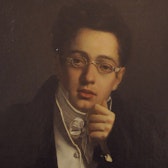
Franz Schubert, the composer, was born in 1797, the son of a Vienna schoolmaster, and received his education as a chorister of the Imperial Chapel.
Composer Biography
Schubert trained as a teacher to devote more time to music after his voice broke, joining his father in the schoolroom by age eighteen.
Recording & Production
This recording of Schubert's Piano Trio No. 2, D. 929, retains 99 bars from the last movement that Schubert cut for the published version.
Critical Reception
Robert Schumann, a German composer and influential music critic, preferred Schubert's Piano Trio No. 2, D. 929, over the first, finding it more spirited, masculine, and dramatic.
Composition History
The Piano Trio No. 2, D. 929, was part of Schubert's only public concert devoted to his work, which took place in March 1828.
Composition History
Schubert's Piano Trio No. 2, D. 929, was first performed at a private party in January 1828 to celebrate the engagement of his school-friend Josef von Spaun.
Compositional Technique
The slow movement of Schubert's Piano Trio No. 2, D. 929, features a melody identified as the Swedish folk-song "Se solen sjunker" (The sun is down).
You might also enjoy...
Schubert: Piano Trio D929 - Sonatensatz D28
Franz Schubert: Piano Trios Nos. 1 & 2
Schubert: Piano Trios Nos. 1 and 2
Schubert: Piano Trio No. 2 in E-Flat, D. 929
Schubert: Piano Trio No. 2, Op. 100
Schubert: Piano Trios Vol. 1
Schubert: Piano Trios Nos. 1 & 2
Schubert Trios: Works for Piano, Violin & Cello
Schubert : The Piano Trios
Schubert: Piano Trios Nos. 1 & 2 - Piano Trio in B flat major, D. 28 - Notturno