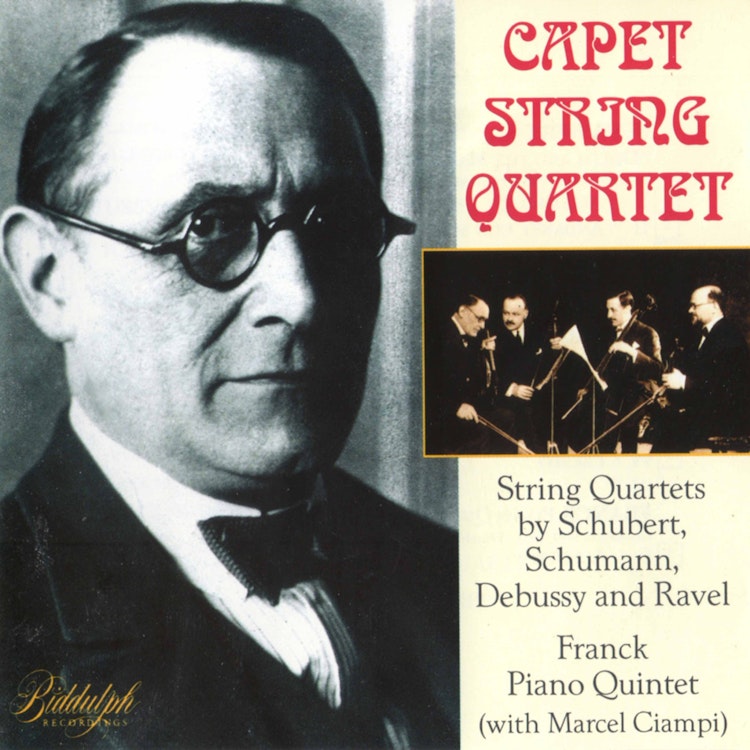
Schubert, Schumann, Debussy & Others: Chamber Works
4/3/2020, 19 Tracks, 2:19:49
Featuring
Lucien Capet
Maurice Hewitt
Henri Benoît
Camille Delobelle
Marcel Ciampi
Capet Quartet
Franz Schubert
Robert Schumann
César Franck
Claude Debussy
Maurice Ravel
Did you know?
1/7
Interpretation
Lucien Capet played in the 19th-century manner, using gut strings and relatively light bowing, and rehearsed meticulously for a pure, homogeneous sound with planned portamenti and transparent chords.
Performer Biography
Marcel Ciampi, the pianist on this recording, was a pupil of Diémer and Chevillard at the Paris Conservatoire and later became a respected piano teacher at the Conservatoire and the Yehudi Menuhin School.
Performer Biography
As a child, Lucien Capet's talent as a violinist was exploited to support his poor family, requiring him to play in cafes, cabarets, and on street corners.
Performer Biography
Lucien Capet was a pupil of Jean-Pierre Maurin at the Paris Conservatoire, who was a grand-pupil of Viotti, and leader of the resident quartet of the Société des derniers quatuors de Beethoven.
Performer Biography
Lucien Capet, the leader of the Capet String Quartet, was born in 1873, the same year as famous musicians like Caruso, Chaliapin, Reger, and Rachmaninoff.
Interpretation
The Capet Quartet's records of the Debussy and Ravel Quartets are considered priceless documents, with their interpretation of the Debussy's slow movement being notably more languid than others.
Performer Biography
Lucien Capet wrote a philosophical treatise titled Espérances, and a significant body of pedagogical work, including his famous 1916 book La Technique supérieure de I'archet.
You might also enjoy...
Debut
Florilegium ('Fatale Flame') - Music from 18th Century France
Francaix, J.: Musique Pour Faire Plaisir / Bozza, E.: Octanphonie / Lavista, M.: Octeto / Toussaint, E.: Oktkt
Russian Performing Art: Vera Dulova, Harp
Paul Juon: Chamber Music for Viola
Bach's Roots. Early Influences on the Young Master