The publisher Tobias Haslinger added 'Die Taubenpost' to Schwanengesang to avoid the unlucky number thirteen, as it was likely the last song Schubert composed.
Composition History
The song 'Abschied' (1816) is a haunting setting of verses by Schubert's troubled friend Johann Mayrhofer, who later committed suicide.
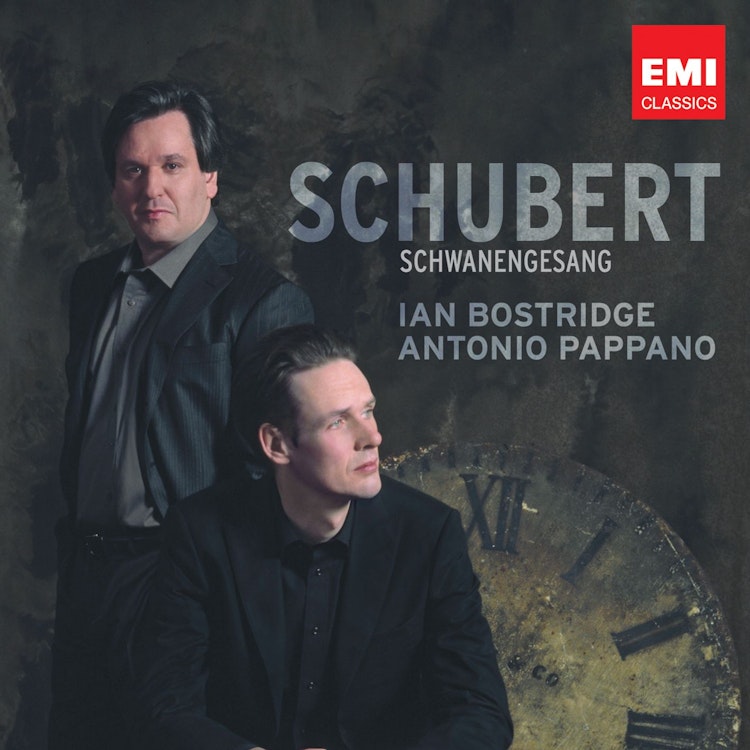
Album & Artwork
The title 'Schwanengesang' (Swansong) was a sentimental and commercially shrewd choice by the publisher, as the songs were not originally conceived as a unified cycle by Schubert.
Composition History
Schubert's last 'song cycle', Schwanengesang, was compiled by his publisher Tobias Haslinger after the composer's death in November 1828.
Compositional Technique
The Heine songs in Schwanengesang are characterized by their concentrated, even claustrophobic intensity, and Schubert heightens their disillusion and Weltschmerz.
Compositional Technique
Schubert's 'Ständchen' (Serenade) is noted for its minor key, which gives it an undertow of sadness, and its long-drawn-out sigh on the final 'beglücke mich!' suggesting melancholy resignation.
Compositional Technique
In 'Der Doppelgänger,' Schubert uses a freely declaimed vocal line over an ominous ground bass, with strange, prophetic harmonies and three heart-rending climaxes.
You might also enjoy...
Schubert: Willkommen und Abschied
Franz Schubert.: Lieder nach Mayrhofer (Lorenz, Shetler)
Schubert: Schwanengesang, D.957; 5 Lieder
Beethoven: An die ferne Geliebte - Schumann: Liederkreis - Wolf & Ravel: Ausgewählte Lieder