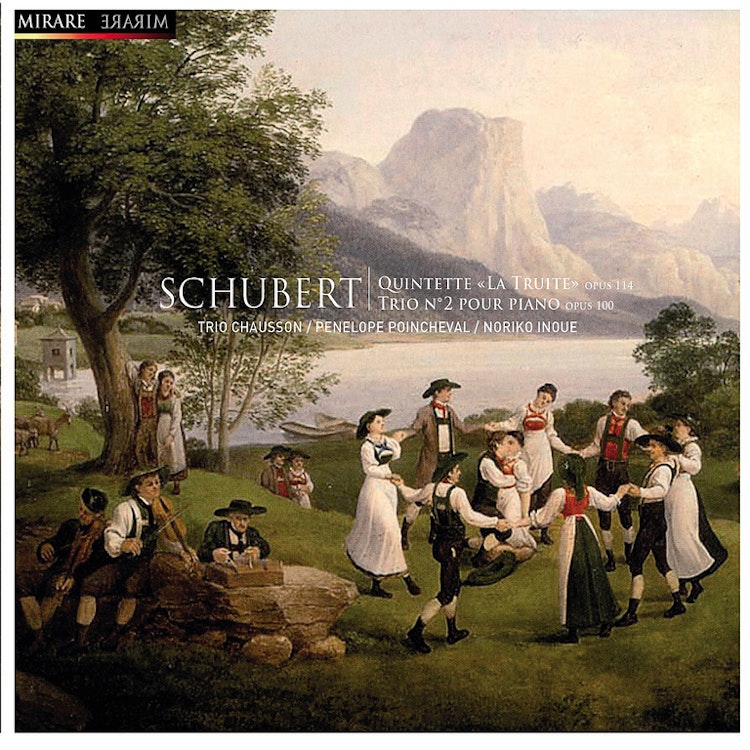
Schubert: Trio pour piano No. 2 - Quintette "La Truite"
9/2/2008, 9 Tracks, 1:14:31
Featuring
Philippe Talec
Antoine Landowski
Boris de Larochelambert
Noriko Inoue
Pénélope Poincheval
Trio Chausson
Franz Schubert
Did you know?
1/7
Critical Reception
The orchestral version of the first eight Slavonic Dances (Op. 46) premiered in Nice, France, on January 14, 1879, and it was in this form that they gained their fame.
Compositional Technique
In his Slavonic Dances, Dvořák does not directly quote folk melodies but instead uses characteristic rhythms to create a 'transfigured folklore' that seems more authentic than reality.
Composer's Artistic Vision
Dvořák was deeply passionate about his native Bohemia and its popular music, drawing inspiration from its folklore since his youth.
Composer Biography
Antonín Dvořák, along with Bedrich Smetana, was a key figure in the revival of Czech music at the end of the 19th century.
Composition History
Dvořák started composing the first set of Slavonic Dances (Op. 46) on March 18, 1878, and sent them to Simrock by May 7, despite having recently lost three of his young children.
Composition History
The Slavonic Dances were commissioned by publisher Simrock, who wanted Dvořák to create a 'Slavic double' to Brahms's successful Hungarian Dances.
Critical Reception
Towards the end of his life, Dvořák expressed irritation that the immense success of his sixteen Slavonic Dances overshadowed the rest of his musical output.