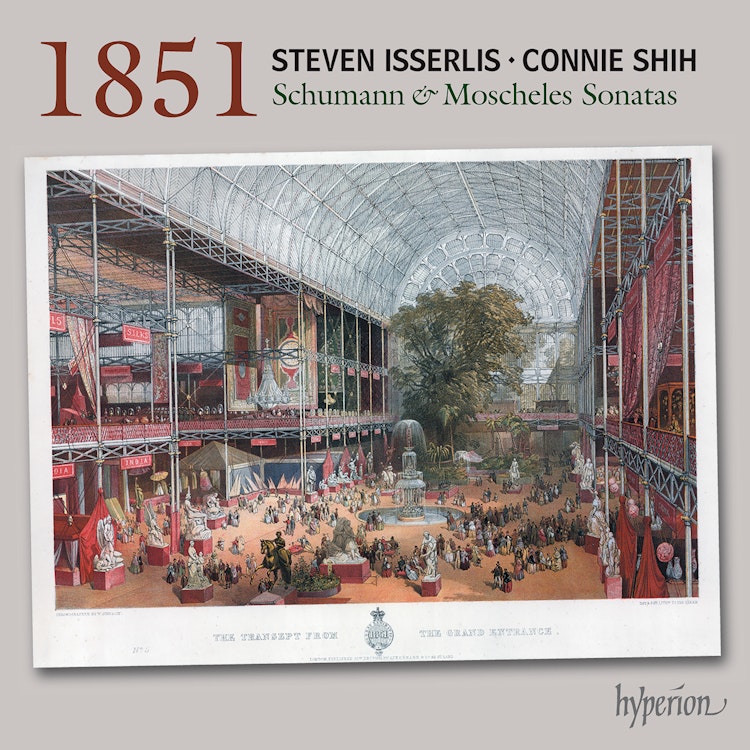
The Great Exhibition of 1851 in London showcased the world's latest achievements, including musical instruments like pianos manufactured by the French firm Érard.
Performer Biography
Steven Isserlis, a British cellist, is acclaimed for his musicianship and technical mastery, enjoying a varied career as a soloist, chamber musician, educator, author, and broadcaster.
Recording & Production
This recording uses an 1851 Érard piano, owned by the University of Birmingham, which may have been one of the instruments displayed at the Great Exhibition.
Composer Biography
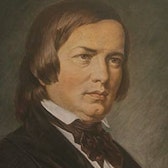
The principal composers on this album, Robert Schumann, Ignaz Moscheles, and Ferdinand David, were part of a close circle of friends in Leipzig, all deeply admiring Felix Mendelssohn.
Historical Context
The year 1851, when many of the works on this album were created or published, was a time of relative peace in Europe, marked by dynamic evolution in the arts, especially music.
Composition History
Robert Schumann composed his Violin Sonata No 2 in D minor, Op 121, in less than a week in 1851, immediately after being dissatisfied with his first violin sonata.
Interpretation
Steven Isserlis, the cellist on this recording, arranged Robert Schumann's Violin Sonata No 2 for cello, noting that Schumann himself authorized such arrangements and that the writing suits the cello's lower register.
You might also enjoy...
Legacy: Lutosławski, Świder, Lasoń
Recital Music for Clarinet
RISE · Revolutionary Russian Cello Music
Music for Cello
Anton Rubinstein: Complete Works for Cello and Piano
Rachmaninoff: Sonata for Cello and Piano Op. 19, Two Pieces for Cello and Piano Op. 2 & Trio Élégiaque No. 1 - Shalygin: “Tristissima” for Cello and Piano
Shostakovich & Prokofiev: Cello Sonatas
Schumann / Schubert: Schumann & Schubert
Afterglow: The Forgotten Works for Cello & Piano by Henry Hadley
Brahms: Sonates pour violoncelle et piano (Intégrale musique de chambre), Vol. 7
Brahms: The Cello Sonatas
Dialogues
Mendelssohn-Bartholdy: Cello Sonata No. 2 in D Major & Strauss: Cello Sonata in F Major