Schumann's Davidsbündlertänze Op. 6, written in 1837, refers to the 'Dances of the League of David', an imaginary music society he created to fight backward artistic structures.
Composer's Artistic Vision
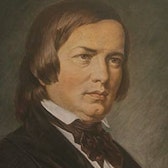
Robert Schumann, the composer, uniquely combined music, literature, and his personal life in his compositions, expressing pure emotion in a 'grey zone between defined feelings'.
Composer's Artistic Vision
The alternation of miniatures and juxtaposed emotions in Schumann's music, like the characters Eusebius and Florestan, is influenced by Jean Paul's literature, where opposing characters represent a singular, complex one.
Composer Biography
Eusebius and Florestan are two main expressions of Schumann's personality in his music and writings: Eusebius is introverted and melancholic, while Florestan is outward and passionate.
Composition History
The Geister-Variationen (Ghost Variations) are Schumann's last work, composed in 1854 shortly before he entered an insane asylum, during a period when he believed he heard ghosts playing music.
Composition History
The Humoreske, written in 1839, is one of Schumann's most extraordinary works, expressing a range of emotions from joy to sorrow, and was referred to by him as his 'grand Humoreske'.
Composition History
Schumann's Davidsbündlertänze were deeply inspired by his love for Clara, a famous pianist, during a period when her father opposed their marriage.