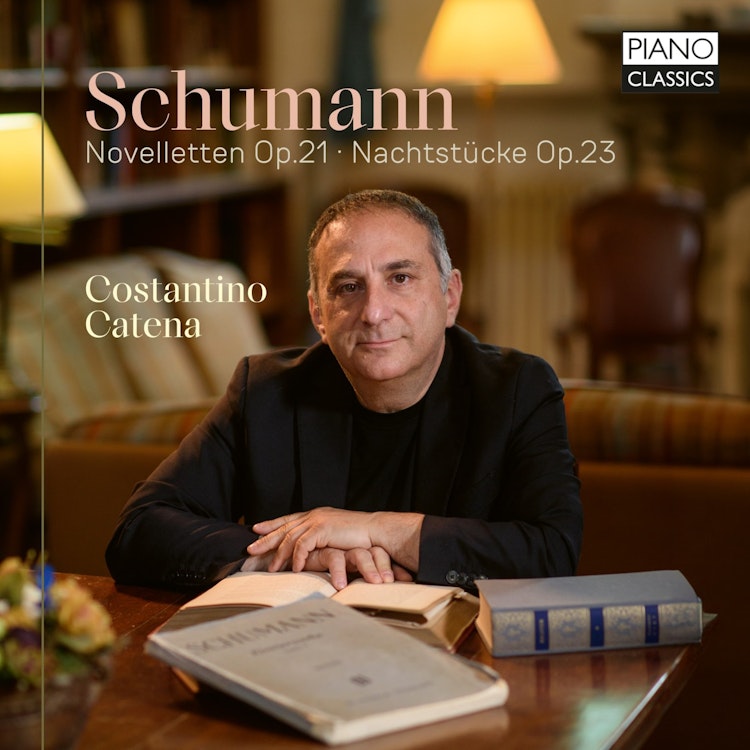
The Nachtstücke Op.23 were conceived by Schumann in 1839, triggered by the grave illness and subsequent death of his brother Eduard.
Composer's Artistic Vision
Schumann named his Novelletten Op.21 after the soprano Clara Novello, but also intended the literary implication of 'novella' to suggest a new musical form.
Composer's Artistic Vision
Schumann initially considered descriptive titles for the Nachtstücke Op.23, such as 'Funeral Procession' and 'Nocturnal Festivities', but ultimately chose a more generic homage to E.T.A. Hoffmann's collection of macabre tales.
Performer Biography
Costantino Catena has recorded the world premiere of piano music by German-Italian composer Ermanno Wolf-Ferrari, rediscovered at the Staatsbibliothek in Munich.
Compositional Technique
Schumann's Novelletten Op.21 incorporate aesthetic principles and narrative techniques from authors like Jean Paul and E.T.A. Hoffmann, using fragments, humor, and intertextual references.
Performer Biography
Costantino Catena, the pianist on this album, is an Italian musician praised for his refined style and expressive skills, with a discography of around 30 titles.
Composition History
Robert Schumann's Novelletten Op.21 were composed in early 1838 during his struggles to marry Clara Wieck, the daughter of his teacher Friedrich Wieck.
You might also enjoy...
Schumann: Piano Sonata No. 2, Faschingsschwank aus Wien